Introduction
The US Iran nuclear talks have become a central issue in international diplomacy, reflecting the global community’s concerns over nuclear proliferation and Middle East stability. These negotiations aim to revive the 2015 nuclear agreement, also known as the Joint Comprehensive Plan of Action (JCPOA), which set limits on Iran’s nuclear program in exchange for sanctions relief. As both nations navigate complex political landscapes, the outcome of the US Iran nuclear talks will play a crucial role in shaping regional security and global diplomatic relations.
In this blog post, we’ll explore the key provisions of the U.S.-Iran nuclear talks.
Context
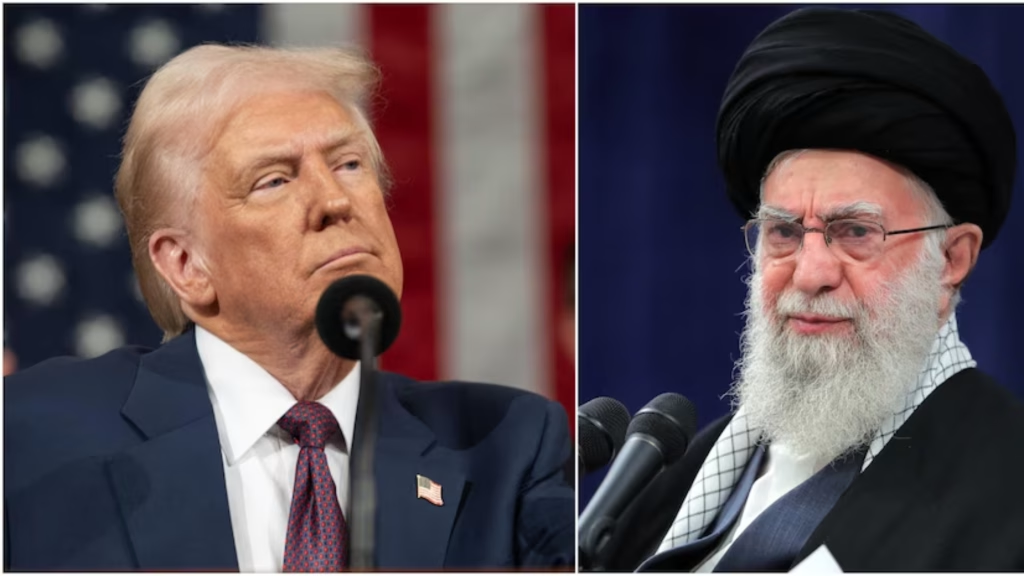
- Iran’s Foreign Minister Abbas Araghchi and United States Special Envoy Steve Witkoff held indirect talks in Muscat on Saturday.
- Their objective is to reach a deal that ends US economic sanctions on Iran, in return for Tehran giving up its stockpile of enriched uranium and attempts towards nuclear weaponization.
- JCPOA and Know about it.
- Why they are at the table?
- a.The Iran factor
- b.The Trump factor
- Impact on Rapprochement 2.0
- What Lies ahead (Issues)?
- Way Forward
JCPOA and Know about it
- Also Known as Iran Nuclear Deal
- Signed in 2015 (with sunset clauses)
- After 10 Years, centrifuge restrictions to be removed.
- After 15 years, limits on low enriched uranium to be removed.
- Parties to the deal: P5 + Germany + The European Union + Iran
Important Terms of JCPOA
- Provided Iran with sanctions relief in return for Tehran severely limiting the scope of its nuclear program.
- Restrictions on Iran:
- Not to enrich its uranium beyond 3.67%, a level suitable for peaceful nuclear power applications but not for weapons production.
- Signing a roadmap agreement with the International Atomic Energy Agency (IAEA).
Note: Trump unilaterally withdrew the US from the deal in 2018, during his first term as president.
Why they are at the Table?
- Just three months into Trump’s second term, the US and Iran are talking for a deal he had walked out of in his first presidency.
- Just three months into Trump’s second term, the US and Iran are talking for a deal he had walked out of in his first presidency.
- The change has been more in Iran than in the United States.
Iran Factor
- Iran is at a watershed moment.
- Demography
- Economy
- Immediate Priority
- Miscellaneous factors
Demography
- The Average Iranian is 32 years old, and the newer generations have not witnessed the three formative events that bind political leaders from older generations — the 1979 revolution, the Iran-Iraq War, and the only succession of a Supreme Leader (Ali Khamenei succeeded Ruhollah Khomeini in 1989).
- This new generation demands change in terms of more freedom and employment opportunity.
Economy
- In August 2024, President Masoud Pezeshkian said Iran needed at least $100B in foreign investment to achieve a growth rate sufficient to slow double-digit inflation and high unemployment rates.
- Iranian leaders, including Araghchi, are advocating doing business with the United States and deals like the one with Boeing in 2015 for 80 commercial aircraft (when the earlier nuclear deal took effect).
Immediate Priority
- Now (with Khamenei healthy but 85 years old), Tehran’s priority is regime preservation and a reduction of threats (especially economic).
- Pezeshkian even said Khamenei was not opposed to US entities investing in the Iranian economy as long as they were genuine investors.
Miscellaneous factors
- Gulf Ties:
- The severe weakening of Iran’s ‘Axis of Resistance’ (even if temporary) has coincided with a strong Arab interest in improving cross-Gulf ties.
- Capitals such as Riyadh, which vociferously opposed the 2015 nuclear deal (along with Israel), are now in favour of a negotiated settlement and greater economic integration.
- Global pressure from allies like Russia: Even Iran’s extra-regional allies such as Russia, who largely stopped pushing Iran to give up nuclear enrichment after Tehran’s support to Moscow over Ukraine — have freshly reiterated the preference for a deal.
Trump 2.0
- Despite economic stresses and Israeli attacks, Iran’s ability to wield influence through its proxies has remained significant.
- The Houthis have shown remarkable agility in choking global trade.
- Also attacking Arab Energy Infrastructure.
- This is bringing new diplomatic arrangements across the Gulf.
- Israel’s increasing unpopularity in the Arab World is also fueling rapprochement between Iran and its Gulf partners.
- This also meant that Trump now faces a dramatically different Middle East than he had experienced during his first term.
- Strategic Space: Trump believes that if Iran responds, it would also cushion any new American concessions to Israel on the Palestine question.
- Mitigation of Iranian Nuclear Risk would be a significant policy achievement.
- Concerned about the continuation of conflict in the Middle East: The longer the conflict the more the Arab-Israel rapprochement unravel (In Trump’s view, one of his finest diplomatic feats).
- Impact on Rapprochement 2.0
Rapprochement 2.0
- USA does not see Russia as a threat anymore.
- The U.S., in that sense, is breaking with the post-Second World War trans Atlantic consensus which see USSR as the most formidable enemy.
- In this Realist worldview, China is the systemic threat to the U.S’s primacy and a Sino-Russian alliance could make that threat perilous.
- It would entail a reorientation of America’s policy towards Russia — in a reverse order of what Henry Kissinger did in the 1970s.
- Seeing the Iran through the same lens
- Change in the world view of USA –
- If USA succeeds in its efforts, USA can reorient its focus towards China.
- It can also break dalliance between China and Iran.
What Lies ahead ?
- At their very core, Washington’s and Tehran’s immediate objectives are aligned — Iranian nuclear disarmament, and economic engagement.
- The question is if the Trump administration will push for more concessions, as it did in 2017, demanding the limiting/eliminating of Iran’s ballistic missile capabilities and a cessation of Iranian support to proxy groups.
- Various issues may emerge up.
Issues
- Strong trust deficit between the USA and Israel on one side and Iran on the other side.
- The 2015 deal was not meant to prevent Iran from acquiring nuclear weapons indefinitely.
- Any American offer that removes these provisions, or imposes even harsher terms, significantly reduces the possibility of an agreement being signed.
Way Forward
- Policy Certainty by the USA
- As a goodwill measure, USA should remove various sanctions and leave its maximum pressure policy.
- Iran must bring its Nuclear facilities within the IAEA watch.
- Ultimately, however, this seeming détente between Tehran and Washington will depend on their ability to silo negotiations from other regional developments, including Israel’s war in Gaza, Syria, and Lebanon.
Conclusion
In conclusion, the U.S.–Iran nuclear talks remain a critical yet fragile diplomatic process. Their outcome will shape regional stability and global non-proliferation efforts for years to come. Continued dialogue is essential to finding a lasting solution.
Join Our Telegram Channel : UPSC With Deepak Prakash