Introduction
“Trump 2.0: Navigating the Nuclear Tension with Iran” marks a potential return to a high-stakes era of international diplomacy and strategic uncertainty. With Donald Trump eyeing another term in the White House, questions are being raised globally about how U.S. foreign policy—especially toward Iran—might shift once again. The Iran Nuclear Deal (JCPOA), previously abandoned under Trump’s presidency, could face renewed pressure, reigniting tensions in the already fragile West Asian region. For UPSC aspirants, understanding this evolving geopolitical equation is crucial—not just for Prelims, but for a broader grasp of India’s strategic environment, energy security, and foreign policy challenges.
J. Robert Oppenheimer, the father of the atomic bomb, is famously quoted saying “Now I am Become Death, the Destroyer of Worlds”. This is a Paraphrase of the Bhagawat Geeta (Chapter 11, 32) that was said in response to the first atomic bomb explosion in July 1945.
Context
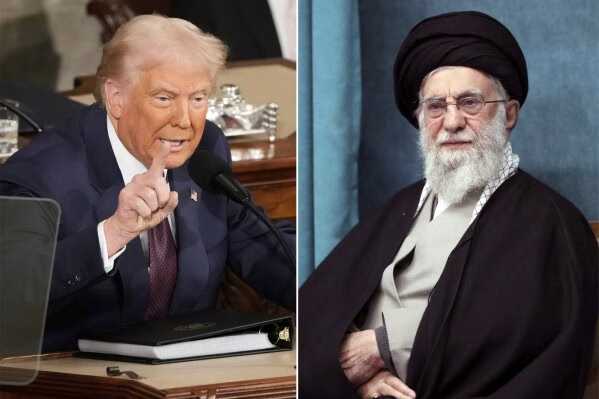
- US President Donald Trump said that he has written to Iran’s Supreme Leader Ali Khamenei about renegotiating a nuclear deal.
- This becomes even more important in the light of recent USA overtures towards Russia(Rapprochement 2.0).
Understanding the Issue:
- What was JCPOA?
- Why did Trump withdraw from the JCPOA Agreement?
- Why does Trump want to renegotiate?
- Role of Rapprochement 2.0 in this turnaround
JCPOA (Joint Comprehensive Plan of Action)
- Also Known as Iran Nuclear Deal
- Signed in 2015 (with sunset clauses)
- After 10 Years, centrifuge restrictions to be removed
- After 15 years, limits on low enriched uranium to be removed.
- Parties to the deal: P5 + Germany + The European Union + Iran
Important Terms of JCPOA
- Provided Iran with sanctions relief in return for Tehran severely limiting the scope of its nuclear program.
- Restrictions on Iran:
- Not to enrich its uranium beyond 3.67%, a level suitable for peaceful nuclear power applications but not for weapons production.
- Signing a roadmap agreement with the International Atomic Energy Agency (IAEA).
Note: Trump unilaterally withdrew the US from the deal in 2018, during his first term as president.
Why did Trump withdraw from the JCPOA Agreement?
- Called this deal as one of “the worst and most one-sided transactions” for the US.
- Failure of the deal to curtail Iran’s ballistic missile programme.
- Lack of checks on Iran’s regional proxies like Hezbollah etc.
Note: These two aspects were central to Saudi and Israeli opposition to the JCPOA.
International Response to Trump Decision
- The withdrawal was met with strong international backlash.
- The IAEA said that Iran was complying with JCPOA-linked restrictions and UNSC Resolution 2231.
- More importantly, European states continued their commitment to the deal.
- In 2018 itself, as new American sanctions hit Iran’s energy, petrochemical, and financial sectors, the EU enforced a Blocking Statute to protect European companies doing “legitimate business” in Iran.
Why does Trump want to renegotiate?
- Despite economic stresses and Israeli attacks, Iran’s ability to wield influence through its proxies has remained significant.
- The Houthis have shown remarkable agility in choking global trade.
- Also attacking Arab Energy Infrastructure.
- This is bringing new diplomatic arrangements across the Gulf.
- Israel’s increasing unpopularity in the Arab World is also fueling rapprochement between Iran and its Gulf partners.
- This also meant that Trump now faces a dramatically different Middle East than he had experienced during his first term.
- Strategic Space: Trump believes that if Iran responds, it would also cushion any new American concessions to Israel on the Palestine question.
- Mitigation of Iranian Nuclear Risk would be a significant policy achievement.
- Concerned about the continuation of conflict in the Middle East: The longer the conflict the more the Arab-Israel rapprochement unravel (In Trump’s view, one of his finest diplomatic feats).
Role of Rapprochement 2.0
Change in the world view of USA –
- USA does not see Russia as a threat anymore.
- The U.S., in that sense, is breaking with the post-Second World War trans Atlantic consensus which see USSR as the most formidable enemy.
- In this Realist worldview, China is the systemic threat to the U.S’s primacy and a Sino-Russian alliance could make that threat perilous.
- It would entail a reorientation of America’s policy towards Russia — in a reverse order of what Henry Kissinger did in the 1970s.
- Seeing the Iran through the same lens
- If USA succeeds in its efforts, USA can reorient its focus towards China.
- It can also break dalliance between China and Iran.
Issues
- Strong trust deficit between the USA and Iran
- The 2015 deal was not meant to prevent Iran from acquiring nuclear weapons indefinitely.
- Any American offer that removes these provisions, or imposes even harsher terms, significantly reduces the possibility of an agreement being signed.
Way Forward
- Policy Certainty by the USA
- As a goodwill measure, USA should remove various sanctions and leave its maximum pressure policy.
- Iran must bring its Nuclear facilities within the IAEA watch.
Conclusion
Trump’s potential return could reshape U.S.–Iran relations, reviving nuclear tensions and impacting global stability. For UPSC aspirants, staying updated on these shifts is vital for understanding international dynamics and their implications for India.
Join Our Telegram Channel : UPSC with Deepak Prakash