Context:
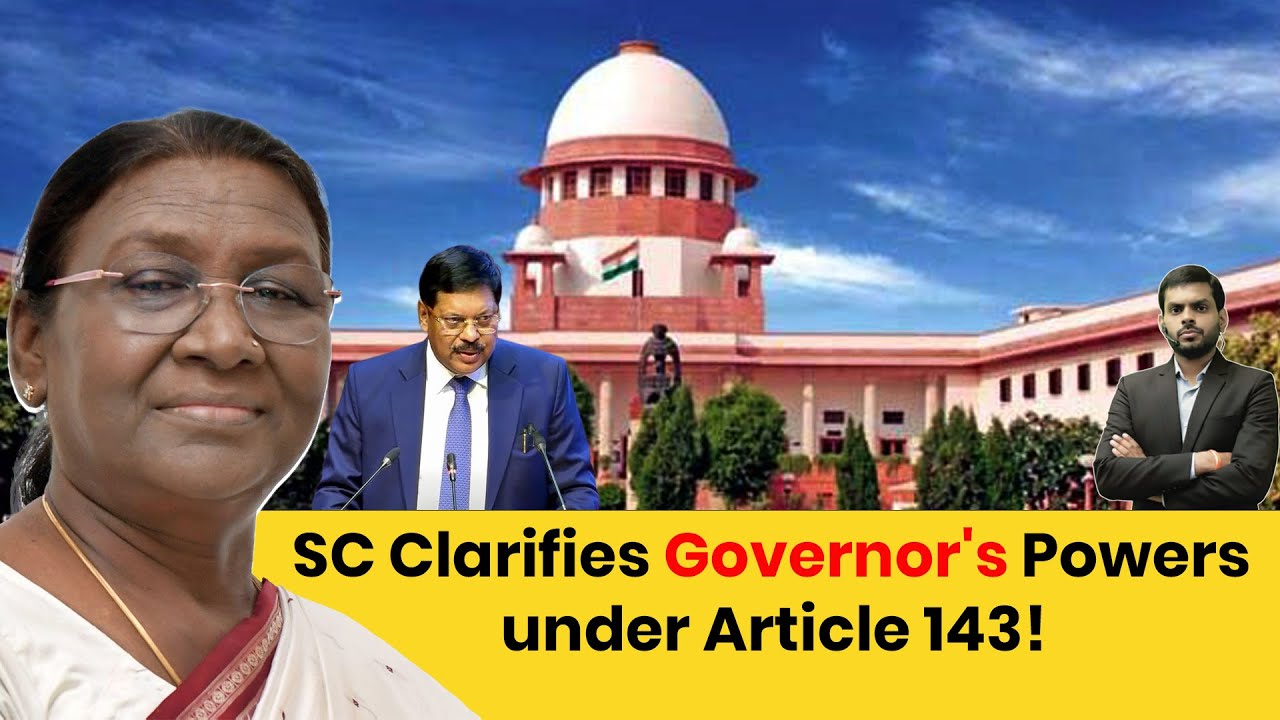
Supreme Court answered the 16th Presidential Reference and has tried to settle the law about the legislative interaction between governors and state governments.
The court ruled that governors can not sit on bills indefinitely, it also held that the judiciary can not impose rigid timelines on constitutional authorities.
This ruling came in response to the Presidential Reference under Article 143(1) of the Constitution.
The opinion unlike a ruling is not binding.
Contents:
What is Supreme Court’s Advisory Jurisdiction?
Procedural requirement under Article 143
Source of Advisory Jurisdiction
Facts for Prelims
Why these questions?
Can the Supreme Court refuse to answer?
Why advisory jurisdiction can not overturn judgements
Breakdown of the 14 questions
Implications of Supreme Court Advisory Opinion on Governor’s Power
Way Forward
Questions for Practice
What is Supreme Court’s Advisory Jurisdiction?
The Constitution (Article 143) authorizes the President to seek the opinion of the Supreme Court in the two categories of matters.
- On any question of Law or fact of public importance which has
arisen or which is likely to arise. - On any dispute arising out of any pre constitution treaty, agreement,
covenant, engagement, sanad or other similar instruments.
Note: In the (1) case, the Supreme Court may tender or may refuse to tender its opinion to the president but in (2) case, the supreme court must tender its opinion to the president.
Procedural requirement under Article 143
Article 145(3) requires any such reference to be heard by five judges, after which the SC returns the reference to the President with the majority opinion.
Under the Constitution, the President acts on the aid and advice of the Cabinet.
The advisory jurisdiction allows her the means to seek independent advice to act on certain constitutional matters.
It is a power that the President has invoked on at least 15 occasions since 1950.
Source of Advisory Jurisdiction
- Taken from Canadian Constitution
- There was also a provision in the GOI 1935 Act to seek the opinion of the Federal court on Question of Law to Question of Fact as well.
Facts for Prelims
- The First Presidential Reference was made in the Delhi Laws Act Case (1951) which laid down the contours of ‘Delegated Legislation’, through which the legislature could delegate legislative powers to the executive for effective implementation of any law.
- This was the 16th Presidential Reference.
- President can refuse to answer (refer Article 143(1)).
- The Supreme Court of India can not overturn its own judgement through the advisory jurisdiction route under Article 143 of the Constitution.
Why these questions?
In “The state of Tamil Nadu vs Governor of Tamil Nadu”, the supreme court imposed various restrictions on the power of governor under Article 200.
Salient aspects of Judgement:
- Governor has no veto under Article 200.
- It fixes timelines for Governor.
- Governor cannot reserve a Bill for the President’s consideration when the
proposed law, which was earlier rejected by him, is presented for the
second time by the State Legislature. - Using Article 142, the Supreme Court declared the 10 Bills as having
received assent.
Can the Supreme Court refuse to answer?
Article 143(1) states the court “may, after such hearing as it thinks fit, report to the President its opinion thereon”.
The word ‘may’ indicates that it is the court’s prerogative to answer the reference.
The SC has so far returned at least two references without answering:
Can the Supreme Court refuse to answer?
In 1993, then President Shankar Dayal Sharma asked the SC “whether a Hindu temple or any Hindu religious structure existed prior to the construction of the Ram Janma Bhumi-Babri Masjid…in the area on which the structure stood.”
Note: Supreme Court refused to answer on three grounds:
a. Civil suit on the dispute was already pending.
b. Reference was also against secularism (hence unconstitutional) (for two Judges)
c. There was apprehension that the government could use the supreme court opinion as a spring board to politically negotiate the issue.
Can the Supreme Court overturn its own judgement through this route?
- In its 1991 opinion on the Cauvery Water Disputes Tribunal, the SC said that Article 143 is not a mechanism for the executive to seek review or reversal of established judicial decisions of the Supreme Court.
- The SC also said it could not “countenance a situation” where a question in a reference “may be so construed as to invite our opinion” on a settled decision of the court.
- The government can, however, file for a review of the ruling, and can move a curative petition in an attempt to reverse it.
Can the Supreme Court overturn its own judgement through this route?
- Since the judgment was by a two-judge Bench, and similar cases from other states, including Kerala and Punjab, remain pending, it is possible that another Bench might refer it to a larger Constitution Bench.
- The Supreme Court of India can not overturn its own judgement through the advisory jurisdiction route under Article 143 of the Constitution.
Why Advisory Jurisdiction can not overturn judgements?
Judicial Finality:
Once the Supreme Court delivers a judgement, it is binding under Article 141 (law declared by the SC is binding on all courts)
Advisory opinion is not judgement:
An advisory opinion doesn’t replace or nullify a prior judgement. It is consultative, not adjudicatory.
Proper routes exist:
To overturn or modify its own judgement, the court must use –
a) Review petition (Article 137)
b) Curative Petition
c) Larger bench over-ruling precedent.
Breakdown of the 14 questions:
Constitutional option before a governor when the bill is presented to him under Article 200?
- To assent,
- To reserve the bill for the consideration of the President
- Withhold assent and return the bill to the legislature with the
comment if the bill is not a money bill
Is the Governor bound by the aid and advice tendered by the Council of Ministers under Article 200?
- No.
- Article 163 of the Constitution states that the Governor must act on the
aid and advice of the Council of Ministers, except where the Constitution
requires them to exercise discretion. - The court ruled that in the specific function of granting assent to Bills,
the Governor enjoys discretion and is not bound by the Cabinet’s advice. - The Bench reasoned that if Governors were bound by the Cabinet, they
could never return a Bill for reconsideration, as no government would
advise against its own legislation.
Is the exercise of constitutional discretion by the Governor under Article 200 justiciable?
- No
- The substantive decision or the merits of why a Governor took a certain step is not justiciable — that is, courts cannot review the wisdom of the decision.
- However, in glaring circumstances of indefinite inaction, the court has a limited power to issue a mandamus to the governor to decide within a reasonable time period.
Is Article 361 an absolute bar to judicial review in relation to the actions of a Governor under Article 200?
- No. (not an absolute bar)
- Article 361 grants the President and Governors personal immunity, stating they are not “answerable to any court” for the performance of their duties.
- The court held that while this protects the individual, it does not protect the “office” of the Governor from judicial scrutiny regarding constitutional inaction.
- The immunity cannot be used to shield indefinite delays.
Can timelines be imposed on the Governor through judicial orders for the exercise of powers under Article 200?
- No.
- The Court overruled its judgment from April which had set specific timelines of one to three months to act on the Bill.
- Since Article 200 uses the elastic phrase “as soon as possible” rather than a fixed timeframe, it would be inappropriate for the judiciary to prescribe rigid deadlines.
Is the exercise of constitutional discretion by the President under Article 201 justiciable?
- No.
- For the same reasoning as held with respect to the Governor, the President’s assent too is not justiciable.
Can the President be bound to timelines while exercising power under Article 201?
- For the same reasons as indicated in the context of the Governor, the President, too, cannot be bound by judicially prescribed timelines.
Is the President required to seek advice of the Supreme Court whenever a Governor reserves a Bill for assent?
- Article 143 allows the President to consult the SC on questions of law.
- However, the President is not required to seek SC’s advice under Article 143 every time a bill is reserved.
- Subjective satisfaction of the President is sufficient.
Are decisions of the Governor/President justiciable at a stage anterior to the law coming into force? Can courts adjudicate the contents of a Bill?
- No.
- The Court ruled that judicial review applies only to “laws”, that is, enacted legislation, not “Bills”, which are proposed legislation.
- Courts cannot adjudicate on the validity of a Bill before it receives assent and becomes law.
Can the exercise of constitutional powers by the President/Governor be substituted under Article 142?
- No.
- Article 142 grants the Supreme Court the power to pass any order necessary to do “complete justice.”
- The Court firmly rejected the concept of “deemed assent” – that is, assuming a Bill is passed if delayed – introduced by a two-judge bench in the April 2025 verdict.
- It held that Article 142 cannot be used to create a legal fiction that substitutes the Governor’s constitutional role.
Is a law made by the state legislature a law in force without the assent of the Governor?
- No.
- A Bill cannot become a law without the specific assent of the Governor – or President, if reserved.
Is it mandatory for any Bench of the court to first decide whether the issues before it involve substantial questions of law that must be referred to a five-judge Bench under Article 145(3)?
- The Court declined to answer this question. Article 145(3) mandates that cases involving substantial interpretation of the Constitution be heard by at least five judges.
- The Court stated this query was irrelevant to the functional nature of the reference regarding legislative assent.
Is the power of the Supreme Court under Article 142 limited to procedural law or does it extend to issuing directions/passing orders which are contrary to or inconsistent with existing substantive or procedural provisions of the Constitution or any law in force?
- The Court found this question too broad to answer definitively but clarified that, as per its response to Question 10, that Article 142 cannot be used to override substantive constitutional provisions like the requirement of assent.
Does the Constitution bar any other jurisdiction of the Supreme Court to resolve disputes between the Union and States except under Article 131?
- The Court declined to answer this question. Article 131 gives the Supreme Court original jurisdiction over disputes between the Centre and States.
- The Bench deemed this irrelevant to the specific issues regarding the Governor’s powers.
Implications of Supreme Court Advisory Opinion on Governor’s Power
No ‘withholding assent simpliciter’
No deemed assent
No judicial timelines
Flexibility preserved
Implications of Supreme Court Advisory Opinion on Governor’s Power
For State governments
Union State relations
Role of judiciary
Way Forward
Legal and Constitutional Steps
Codify timelines through legislation
Strengthen judicial oversight
Institutional Steps
Role of governor (should act as a neutral constitutional head)
Executive accountability (Union government to ensure that appointed governor respect constitutional boundaries)
Political Steps
Institutionalized consultation between governors and CMs before exercising Article 200 or 201 Transparency in decision making in governor.
Questions for Practice
The Supreme Court’s advisory opinion under Article 143 clarified the limits of Governors’ discretion under Articles 200 and 201. Discuss the constitutional implications of this opinion for Centre–State relations in India.
Advisory jurisdiction under Article 143 is consultative, not corrective. In light of this statement, analyze the significance and limitations of advisory opinions in shaping constitutional conventions.
Critically examine the role of Governors in the legislative process under Articles 200 and 201.
Subscribe Our Youtube Channel: https://www.youtube.com/@CivilsPhodo