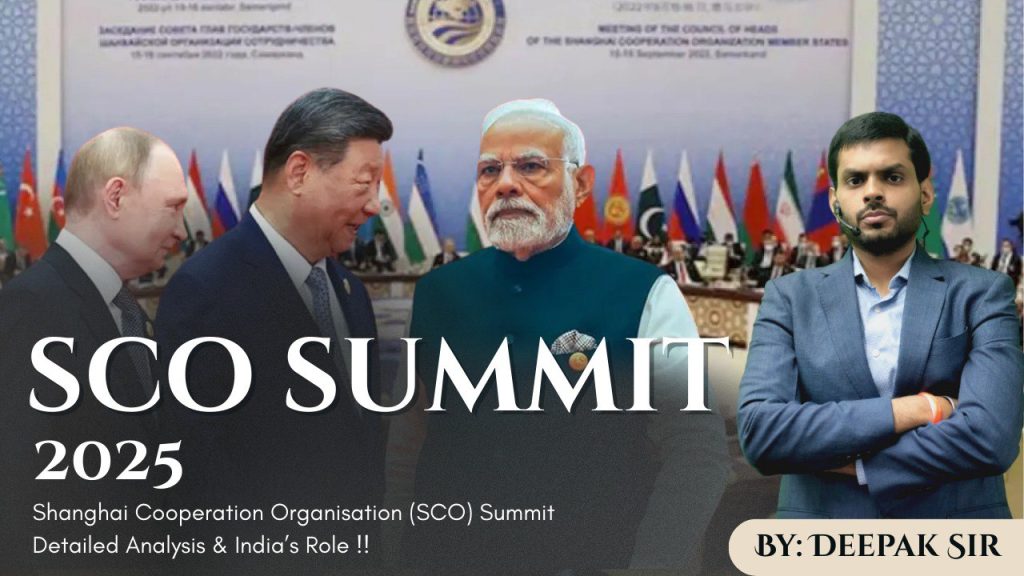
The Shanghai Cooperation Organisation (SCO) has gradually emerged as one of the most significant regional platforms in Eurasia. Originally seen as a grouping focused on border stability and counter-terrorism, it has now expanded into discussions of trade, energy, connectivity, and even cultural cooperation. The 25th SCO Summit, held in Tianjin, China, in 2025, was not just another annual diplomatic event. It came at a time when the global order is shifting towards multipolarity, with China and Russia working closely to shape an alternative to Western-led institutions, and countries like India using the forum to advance their interests without compromising their independence.
This article provides a comprehensive breakdown of the key outcomes of the Tianjin summit, India’s role and gains, and the broader implications for the world.
Understanding the SCO: From “Shanghai Five” to Global Forum
The SCO’s journey began in 1996 as the “Shanghai Five”, a grouping of China, Russia, Kazakhstan, Kyrgyzstan, and Tajikistan. Its initial purpose was to resolve border disputes and build mutual trust in a post-Soviet environment. By 2001, the organisation formally evolved into the SCO, and over time, it expanded to include India, Pakistan, and Iran along with observer states and dialogue partners.
Today, the SCO represents around half of the world’s population and a significant portion of global GDP. Unlike NATO, it is not a military alliance; unlike the EU, it is not an economic bloc. Instead, it positions itself as a flexible platform for:
- Security cooperation – particularly against the “Three Evils” of terrorism, separatism, and extremism.
- Economic and trade initiatives – with emphasis on connectivity and infrastructure.
- Cultural, educational, and humanitarian cooperation – to build stronger people-to-people ties.
The SCO has sometimes been criticized for being “all talk and no action.” Yet, its symbolism and institutional reach cannot be ignored, especially at a time when Asia is becoming the centre of global geopolitics.
Key Outcomes of the Tianjin Summit
1. Adoption of the Tianjin Declaration and Long-Term Strategy
At the heart of the summit was the signing of the Tianjin Declaration, along with a package of nearly two dozen documents. The most significant among them was the SCO Development Strategy 2035, which outlines the organisation’s vision for long-term cooperation.
This document emphasizes a coordinated approach to regional security, economic integration, sustainable development, and digital transformation. While ambitious, the challenge remains in translating words into concrete projects, given the diversity of interests among member states.
2. Renewed Focus on Security and Counter-Terrorism
Security has always been the SCO’s strongest point of cooperation. At Tianjin, the summit took a bolder step by explicitly mentioning recent terrorist incidents in member states — including those affecting India. This was a diplomatic gain for New Delhi, as it ensured that its security concerns were not ignored.
The summit also strengthened the Regional Anti-Terrorist Structure (RATS), with commitments to better intelligence-sharing, joint exercises, and a more coordinated approach to tackling cross-border terrorism.
3. Tackling Transnational Threats
Beyond terrorism, the summit discussed drug trafficking, cybercrime, and organised crime as shared threats. These issues cut across borders and require joint responses. The adoption of new cooperation mechanisms in these areas reflects the SCO’s effort to remain relevant in a rapidly evolving security landscape.
4. Economic and Connectivity Ambitions
Although the SCO is not a structured economic union, the 2035 strategy highlighted trade facilitation, cross-border connectivity, energy cooperation, and the digital economy. Infrastructure projects, regional railways, and digital trade platforms were discussed, though much of this overlaps with China’s Belt and Road Initiative (BRI).
India, while supportive of connectivity in principle, has remained cautious about initiatives directly linked to the BRI. The Tianjin summit allowed India to voice its concerns while also engaging in conversations about alternative routes and projects.
India at Tianjin: Diplomacy and Strategic Autonomy
Diplomatic Balancing Act
India’s presence at the summit was a clear demonstration of its strategic autonomy. Prime Minister Narendra Modi’s participation and interactions with leaders of both China and Russia highlighted India’s independent foreign policy approach. Delhi neither blindly aligns with Western blocs nor fully commits to Eastern institutions. Instead, it engages with both, ensuring that Indian interests remain protected.
Gains on the Security Front
One of India’s biggest achievements at the summit was the explicit acknowledgment of terrorist incidents affecting it. For years, India has pushed to make counter-terrorism a central agenda item in international forums. The Tianjin Declaration was a step in that direction, giving India diplomatic validation.
Economic Opportunities
On the economic front, India welcomed discussions on trade, digital cooperation, and sustainable development. However, Delhi stayed cautious regarding connectivity projects tied to the BRI. By doing so, India managed to keep the door open for future cooperation while avoiding entanglement in projects that may compromise its sovereignty.
The Bigger Picture: SCO Summit 2025
China’s Vision of Leadership
For China, hosting the 2025 summit was an opportunity to showcase leadership in global governance. By shepherding the declaration and long-term strategies, Beijing positioned itself as the architect of regional cooperation, offering a multipolar alternative to Western-led institutions.
Russia’s Diplomatic Needs
For Russia, the SCO provides a much-needed diplomatic platform to demonstrate influence. Facing pressure from the West, Moscow sees the SCO as a way to deepen ties with Asia, particularly with China and India. The Tianjin summit reinforced Russia’s role in shaping Eurasian geopolitics.
A Multipolar Signal to the World
The summit highlighted a key trend: the world is moving away from unipolarity. While the SCO is not yet capable of replacing Western-led organisations, its collective weight cannot be ignored. Its declarations, joint exercises, and long-term strategies indicate the rise of non-Western voices in global decision-making.
Lessons and Takeaways
For analysts, students, and policymakers, the Tianjin summit offers several lessons:
- India’s Strategic Autonomy in Practice
The summit showed how India maintains a delicate balance — engaging with the SCO while continuing to strengthen its partnerships with the West. This is a textbook example of strategic autonomy. - Security as the SCO’s Core Strength
Unlike economics or trade, security cooperation remains the SCO’s most practical and impactful area. The Regional Anti-Terrorist Structure has the potential to become a stronger mechanism for collective action. - Economic Aspirations vs. Political Realities
While the summit produced ambitious economic roadmaps, actual implementation will depend on whether member states can overcome political rivalries and align national priorities.
Conclusion
The SCO Summit 2025 in Tianjin was more than a ceremonial gathering. It showcased the organisation’s continuing relevance, delivered significant diplomatic wins for India, and highlighted the ambitions of China and Russia to reshape global governance.
For India, the summit was a stage to push for recognition of its security concerns, safeguard its economic interests, and assert its independent foreign policy. For the world, the summit was a reminder that multipolarity is no longer a distant idea but an emerging reality.
Yet, the future of the SCO depends on its ability to move beyond declarations and implement real projects. Whether it becomes a powerful driver of Eurasian cooperation or remains a symbolic forum will be determined in the years ahead.