
Introduction
The Indus Water Treaty is a landmark agreement between India and Pakistan that governs the use of waters from the Indus River system. Signed in 1960 under the mediation of the World Bank, the treaty has played a crucial role in managing water resources and maintaining relative peace between the two countries, despite periods of political tension. By allocating the use of specific rivers to each nation, the Indus Water Treaty remains a significant example of successful international water-sharing cooperation.
In this blog post, we’ll explore the key provisions of Suspension of Indus Water Treaty .
Context
- The Indus Waters Treaty (IWT), which has survived three wars, decades of cross-border terrorism against India by Pakistan, and a long history of antagonism between the two countries, was suspended for the first time by New Delhi on Wednesday.
- The reason behind this decision is Pahalgam attack.
- Among the slew of diplomatic actions against Pakistan announced by India — including the closure of the Attari border post, cancellation of visas, and the expulsion of several Pakistani personnel from India – the suspension of the IWT may have the most far-reaching ramifications.
Content
- Indus Water Treaty
- Know about Indus and its tributaries
- Significance of this decision for India
- What options does Pakistan have?
- Can India walk out of Indus treaty
- Implications of it.
- Way Forward
What is the Indus Water Treaty?
- Indus The IWT was signed in Karachi on September 19, 1960,following nine years of negotiations between India and Pakistan. The Treaty has 12 Articles and 8 Annexures (from A to H).
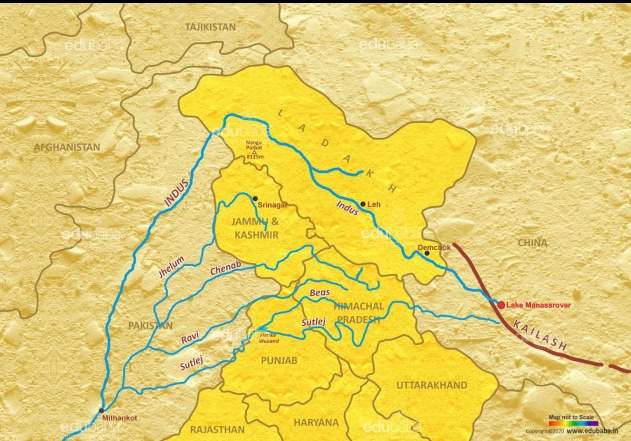
- According to the provisions of the Treaty, all the water of the “Eastern Rivers” of the Indus system — Sutlej, Beas and Ravi — shall be available for the “unrestricted use” of India.
- Pakistan shall receive water from the “Western Rivers” — Indus, Jhelum, and Chenab.
Know about Indus and its tributaries
Significance of this decision for India
- Will give more options to India on how to use the waters of the Indus river system
- India can immediately stop sharing water flow data with Pakistan.
- There will be no design or operational restrictions on India for the use of the water of the Indus and its tributaries.
- India can now create storage on the Western Rivers, Indus, Jhelum and Chenab.
- India can also stop visits by Pakistani officials to the two hydroelectric projects currently under construction in Jammu & Kashmir — the Kishenganga HEP on Kishenganga, a tributary of the Jhelum, and the Ratle HEP on the Chenab.
- India can undertake reservoir flushing (a technique used to remove accumulated sediment from reservoirs by releasing water through low-level outlets to scour out the sediment and transport it downstream) on the Kishenganga project, which will increase the life of the dam.
Note:However, the suspension will not have an immediate impact on the flow of water to Pakistan for a few years at least.
What options does Pakistan have?
- While the World Bank-brokered treaty does not mention that the UN’s judicial arm, the International Court of Justice (ICJ), can intervene, it does establish a three-tiered resolution mechanism.

- According to the three-pronged mechanism, the Permanent Indus Commission (PIC), comprising commissioners from both countries, is the initial point for resolving disputes arising out of water sharing between the two nations.
- However, if the issue fails to be resolved by the PIC, it is then referred to a World Bank-appointed neutral expert, as was the case in the recent disputes between India and Pakistan over the Kishenganga and Ratle hydroelectric projects.
- Finally, the matter can be taken to the Permanent Court of Arbitration (PCA) in The Hague under the provisions of Article IX.
Can India walk out of Indus treaty?
- The Indus Waters Treaty lacks an exit clause, meaning neither India nor Pakistan can legally abrogate it unilaterally.
- The Treaty has no end date, and any modification requires the consent of both parties.
- The provisions of this Treaty, or the provisions of this Treaty as modified under the provisions of Paragraph (3), shall continue in force until terminated by a duly ratified treaty concluded for that purpose between the two governments,” says Article XII of the IWT.
- Under a circumstance where India wants to abrogate the treaty, the 1969 Vienna convention on the law of treaties, which regulates the formation, regulation and termination of treaties between two sovereign states, comes into play.
- India is not a signatory to the Vienna Convention on the Law of Treaties. However, India takes guidance from relevant sections even though it is not party to the 1969 Convention.
Implications of it
For Pakistan, the Indus system is not just vital—it is existential.
- 80% of Pakistan’s cultivated land—about 16 million hectares—relies on water from the Indus system.
- 93% of this water is used for irrigation, powering the country’s agricultural backbone.
- The system supports over 237 million people, with Pakistan accounting for 61% of the Indus Basin population.
- Major urban centres—Karachi, Lahore, Multan—draw their water directly from these rivers.
- Hydropower plants like Tarbela and Mangla also depend on uninterrupted flows.
- Escalation of geopolitical tensions: It is likely to escalate tension between India and Pakistan
- Threat to regional stability:The Indus river basin is shared by India, Pakistan, China and Afghanistan. Instability in the IWT could have ripple effects on water cooperation in the wider region.
- Damage to India’s International Standing- Unilaterally suspending or withdrawing from the IWT could damage India’s image as a responsible global power. It may be a setback for future negotiations of water treaties, like the Teesta Water Treaty with countries like Bangladesh.
- Giving an opportunity to China:
- Diversion of water is seen as a legitimate reason to declare war in international law.
- 20% of India’s Northern water flow depends on glacial melt from Tibet.
- Many strategists are suggesting that this decision of India give china the legal precedent to weaponise water against us.
Way Forward
- As PM Modi Stated water and blood cannot flow together.
- Cross border terrorism must be stopped.
- Although this move could set a concerning precedent if adopted by other upstream Neighbouring countries, it is seen as a necessary retaliation against the recurring attacks on Indian soil.
Conclusion
In conclusion, the Indus Water Treaty stands as a vital framework for water cooperation between India and Pakistan. Despite the complexities of their bilateral relationship, the treaty has endured for decades, highlighting the importance of diplomacy and mutual understanding in managing shared natural resources. As water scarcity becomes an increasing global concern, the Indus Water Treaty continues to serve as a model for peaceful and practical conflict resolution over transboundary water issues.
Join Our Telegram Channel : UPSC With Deepak Prakash