
Introduction:
The Indo-Pak wars have shaped the political and military landscape of South Asia for over seven decades. Marked by deep-rooted historical tensions, territorial disputes, and complex geopolitical dynamics, these conflicts between India and Pakistan have had far-reaching consequences—not just for the two nations involved, but for global diplomacy and regional stability. In this blog post, we break down the origins, key events, and outcomes of each major Indo-Pak war, offering a clear and concise explanation for readers seeking to understand one of the most enduring rivalries in modern history.
Context:
- Escalating tensions, Pakistan launched drone and missile attacks at various locations along the western borders with India late on Thursday evening, but the Indian armed forces swiftly intercepted them, official sources said.
- This came after the Indian air defense systems thwarted Pakistan’s attempts to strike civilian and military locations in northern and western India with a “substantial” number of missiles and loitering munitions in the early hours of Thursday.
- India has also launched retaliatory strike late in the evening yesterday.
Chapters:
- Pahalgam Attack and immediate implications.
- Operation Sindoor
- Map of Nine locations that were targeted.
- Key takeaways from operation sindoor.
- Precision guided long range weapons in India
- Important terrorist outfits of Pakistan
- Air defence system: How it works?
- Role of S-400 Triumf, Barak 8 MRSAM and Indigenous Akash
- About HAROP drone
- Comparing the India and Pakistan’s military and nuclear capabilities
Chapter 01: Location of Pahalgam and immediate implications
- On April 22, 2025, in Pahalgam 26 people were killed in a tragic and shocking act of terrorism.
- Pahalgam is a picturesque tourist destination in Anantnag district, J&K.
- It happened in Baisaran valley, a scenic spot in Pahalgam, J&K. The valley is popularly called ‘Mini Switzerland’.
- Initial intelligence points to The Resistance Front involvement in this attack (It is a shadow organization of banned Pakistani terror outfit Lashkar-e-Taiba).
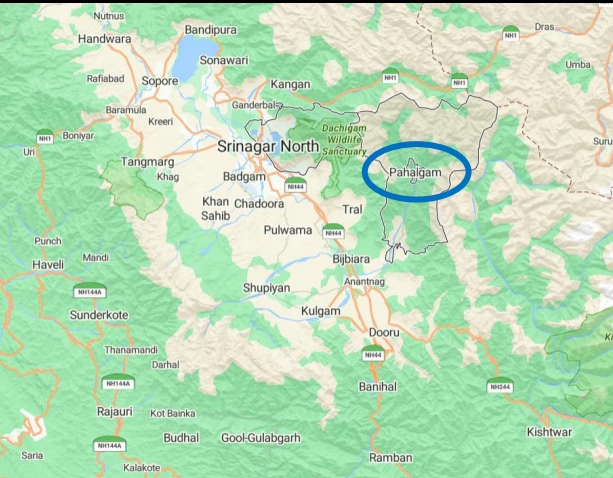
Immediate implications of Pahalgam attack
- The Indian security forces immediately launched operation Tikka, a high level counter terror operation in J&K with the ultimate goal of neutralizing the attackers.
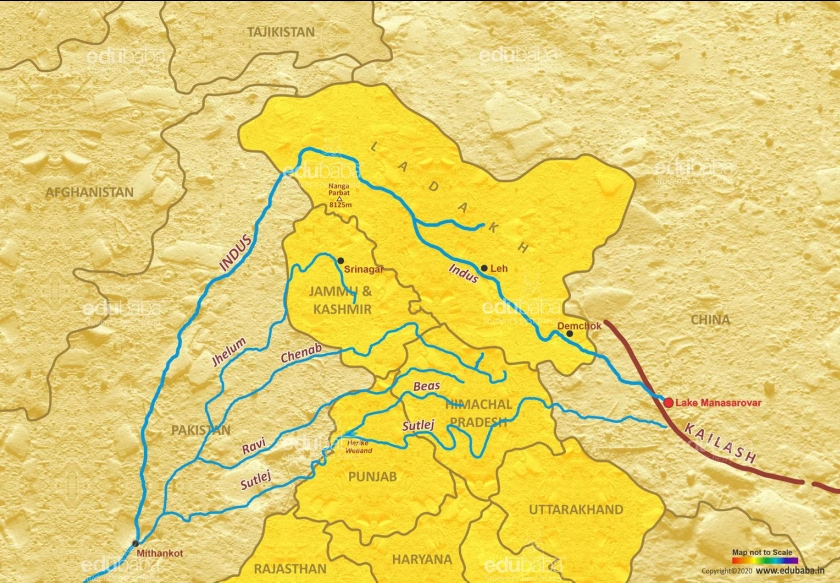
- The Indus Waters Treaty (IWT), which has survived three wars, decades of cross-border terrorism against India by Pakistan, and a long history of antagonism between the two countries, was suspended for the first time by New Delhi on Wednesday.
- Among the slew of diplomatic actions against Pakistan announced by India — including the closure of the Attari border post, cancellation of visas, and the expulsion of several Pakistani personnel from India – the suspension of the IWT may have the most far-reaching ramifications.
Know about Indus and its tributaries
Chapter 02: Operation Sindoor
About:
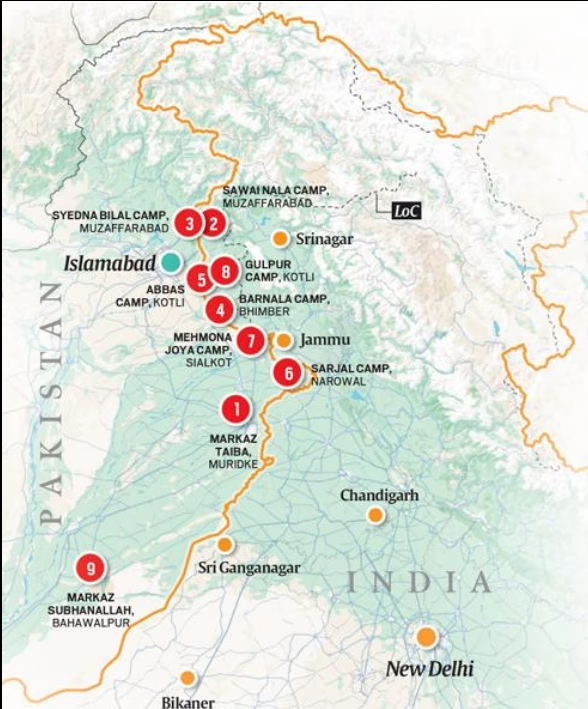
- India launched operation sindoor on 7th May targeting terrorist camps across nine locations in Pakistan and PoK.
- Some of these camps were recruitment and indoctrination centres, training areas for initial courses and launched pad for handlers.
- Some of the important locations that were targeted were:
- Bahawalpur(known for Jaish-e-Mohammed, which was founded by Masood Azhar) and Muridke(known for Lashkare-Taiba and it’s founder Hafiz Saeed) in Pakistan’s Punjab,
- Muzaffarabad and Kotli in PoK.
Map of Nine locations that were targeted.
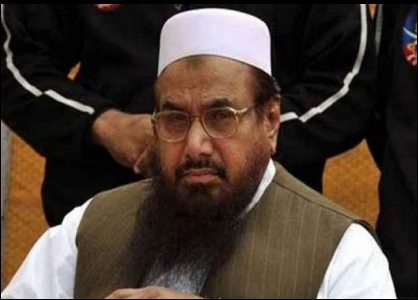
- Markaz Taiba, Muridke
- Hafiz Saeed’s headquarters, nerve centre of Lashkar-eTaiba
- The Markaz Taiba in Muridke in Pakistan’s Punjab province is the headquarters of the Lashkar-e-Taiba (LeT), and its front, the Jamaat-ud-Dawa (JuD).
- Besides being a site of training and recruitment, the sprawling 200-acre campus serves as the ideological nerve centre of the LeT. It is here that all key terror attacks of the Lashkar are planned and directed.
- The terrorists involved in the 2008 Mumbai attacks — including Ajmal Kasab and David Headley — were trained here.
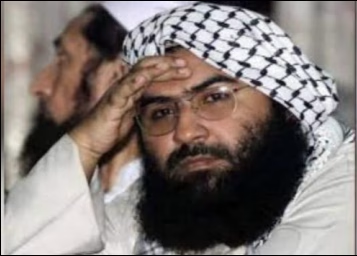
- Markaz Subhanallah, Bahawalpur
- Headquarters of Jaish-e-Mohammed, base of Masood Azhar. Markaz Subhanallah in Bahawalpur in Pakistan’s Punjab province.
- Masood Azhar established the JeM in 1999, soon after his release from an Indian prison following the IC 814 hijacking. From the very beginning, the JeM maintained a base at Bahawalpur, Azhar’s hometown.
- This complex is situated only 8 kilometres from the headquarters of the Pakistan Army’s 31 Corps. Sources said the JeM facility has been associated with the 2016 Pathankot airbase attack, and the 2019 Pulwama suicide bombing, which resulted in the deaths of 40 Central Reserve Police Force (CRPF) personnel.
- Sawai Nala camp, Muzaffarabad
- Major LeT camp in PoK, where Pahalgam terrorists trained
- This camp in Pakistan Occupied Kashmir (PoK) is located 30 km from the LoC, and is the LeT’s most important training centre.
- Syedna Bilal camp, Muzaffarabad
- Camp for Lashkar and Jaish, terrorist recruits are provided training by Pakistani special forces.
- Barnala camp, Bhimber
- Close to the LoC, training camp for mountain and jungle terrain, launchpad for infiltrators
- Abbas camp, Kotli
- Indoctrination centre and school for fidayeen recruits, located close to Pakistani military camp.
- Sarjal camp, Narowal
- Near International Border in Pakistani Punjab, regrouping site before specialised terror training.
- Mehmona Joya camp, Sialkot
- Initial induction centre for terrorists who infiltrate through Punjab and Jammu.
- Gulpur camp, Kotli
- Base of Lashkar units active in Rajouri and Poonch districts.
Key takeaways from operation Sindoor.
- India framed operation Sindoor as a reply to the string of attacks since 2001.
- India targeting camps/sites of multiple terrorist organizations under cuts Islamabad attempt to focus only on Pahalgam.
- India, until yesterday, focused on the terrorist infrastructure across the line of control/international border without deliberately targeting the Pakistani military.
- Implication: India continues to make a distinction between terrorist infrastructure and Pakistan military targets in order to preserve some element of escalation control
- While striking Pakistan, India has signalled that it does not seek full-scale war. But what happens from yesterday is a cause of concern.
- India has described Sindoor as “focused, measured and non-escalatory in nature”, signaling to Pakistan and the international community that it does not seek full-scale conventional war.
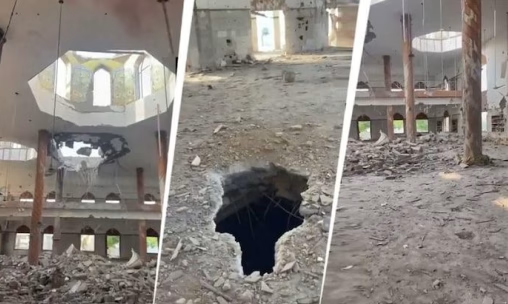
Chapter 03: Precision guided long range weapons in India
- India has not revealed what weapons were used in Operation Sindoor early on Wednesday morning (May 7). The official statement said that the Indian Armed Forces carried out precision strikes, hitting terrorist infrastructure deep inside Pakistan and in Pakistan occupied Kashmir (PoK).
- Over the past several years, the Indian military has built up a formidable arsenal of new-age weapons that includes a range of precision-guided long-range weapons and drones, including loitering munitions.
Some of the important such weapons are:
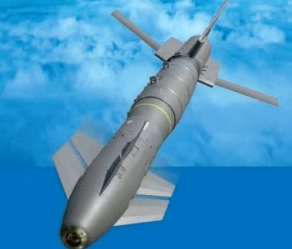
- HAMMER:
- The Highly Agile and Manoeuvrable Munition Extended Range
- Air-to ground precision-guided weapon system for the Rafale fighter aircraft.
- Range of up to 70 km,
- can also be fitted to bombs and various guided systems.
- Built by the French aerospace, defence, and security corporation Safran
- According to the Safran Group, the system is autonomous and insensitive to jamming, and can be launched from a low altitude over rough terrain.
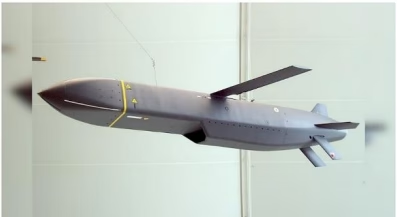
- SCALP:
- Air-launched cruise missile with stealth features designed for long-range deep strikes.
- Known as Storm Shadow in Britain, can be operated at night and in all weather conditions.
- The missile, manufactured by the European multinational MBDA, has a range of 450 km.
- Its advanced and highly accurate navigation system, which uses Inertial Navigation System (INS), Global Positioning System (GPS) and terrain referencing, can penetrate bunkers and ammunition stores.
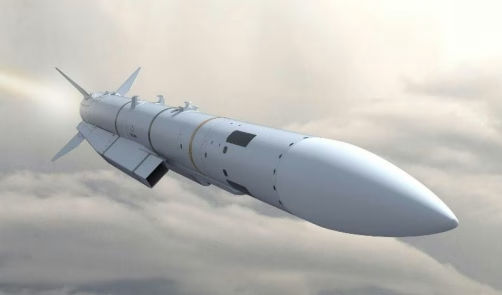
- METEOR:
- The Meteor is a new-generation Beyond Visual Range Air-to-Air Missile (BVRAAM) system which is effective in dense electronic-warfare environments.
- Manufactured by MBDA.
- The missile’s solid-fuel ‘ramjet’ motor provides it with thrust all the way to the target intercept, and thus the largest ‘No Escape Zone’ of any air-to-air missile system.
Note: Dense Electronic Warfare System:
A “dense electronic warfare environment” refers to a situation where the electromagnetic spectrum is saturated with a high number of signals, making it challenging for electronic warfare systems to effectively detect, identify, and counter threats. This high density of signals can lead to interference and reduced performance of EW systems, requiring them to be designed and operated with specific considerations for dense environments.
Note: A Ramjet is a form of air breathing jet engine that requires forward motion of the engine to provide air for combustion.
Note: The “no-escape zone” of an air-to-air missile system refers to the area where there is a very high probability of a missile hitting its target, even if the target is aware of the threat and attempts to evade.
- BRAHMOS:
- These supersonic cruise missiles, which have been operationalised in all three defence services
- Built by BrahMos Aerospace, a joint venture between India’s Defence Research and Development Organisation (DRDO) and Russia’s NPO Mashinostroyeniya.
- BrahMos missiles operate at close to Mach 3 speed in the cruise phase.
- The missile operates on a ‘Fire and Forget Principle’, adopting varieties of flights on its way to the target.
- Cruising altitude could be up to 15 km and terminal altitude as low as 10 metres.
- Notes:
- Cruising altitude refers to the height above sea level where an aircraft spends most of its flight, typically between 30,000 and 42,000 feet for commercial airliners. Terminal altitude, on the other hand, refers to the altitude of an aircraft during its final approach and landing, often lower than cruising altitude.
- The “fire and forget” principle, primarily used in missile technology, refers to a type of missile guidance system where the missile, once launched, can autonomously guide itself to its target without further external intervention.
Classification of Missiles based on speed
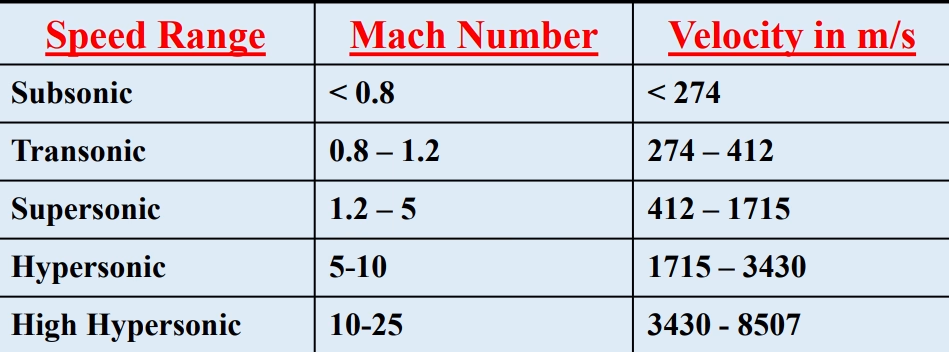
- Loitering Munitions:
- Loitering munitions are aerial weapons that combine surveillance and strike capabilities, allowing them to identify and engage targets with precision.
- These systems can be operated autonomously or manually, offering real-time intelligence and the ability to strike at the right moment.
- In recent years, the Indian Armed Forces have been actively procuring various types of drones, including loitering munitions, to enhance situational awareness and precision strike capabilities.
- For example, Nagastra-1, built by Solar industries, and located in Nagpur.
- Kamikaze drone:
- Kamikaze drones are small, explosive UAVs designed for precision strikes.
- Kamikaze Drone are unmanned aircraft that are packed with explosives and flown directly at a tank or group of troops that are destroyed when they hit the target and explode.
- These drones are also known as Switchblade drones.
- These compact, weaponised drones are challenging to detect by radar and can be pre-programmed using facial recognition technology to autonomously engage targets.
Note: Called as “Switchblade” because their wings are folded inside a tube and then flipped out upon launch
Chapter 04: Important terrorist outfits of Pakistan
- Pakistan’s terror infrastructure has survived for decades within its security establishment, which views these forces as strategic assets.
- The Soviet-Afghan War of 1979 was the inflection point when Pakistan’s Inter Services Intelligence (ISI), backed by U.S. funding, systematically cultivated jihadi infrastructure that evolved into today’s sophisticated terror network.
Some of the important terrorist outfit which are said to have Pakistan support are:
- Lashkar-e-Taiba
- The LeT emerged in the 1990s as Pakistan’s premier proxy organisation against India
- it operates under Hafiz Muhammad Saeed — a designated terrorist operating in Pakistan despite international sanctions
- Ideologically, the outfit adheres to the virulent Ahl-e-Hadith doctrine (a conservative faction with a strict adherence to the Koran) specifically targeting India, which it propagates through its network of 300+ madrassas across Pakistan.
- Some of the important attacks: 2008 Mumbai attacks, 2006 Mumbai train bombings, 2010 German Bakery bombing in Pune (indirect).
- LeT maintains transnational reach with recruitment networks identified in 21 countries, with dedicated cells both in Bangladesh and Nepal facilitating operations against India.
- Its financial architecture combines direct ISI funding, estimated to be around $25-50 million annually; gulfbased private donors from Saudi Arabia and the UAE
- Jaish-e-Mohammad
- Established in 2000 by Masood Azhar following his ‘release’ during the IC-814 hijacking, the JeM represents Pakistan’s suicide terrorism capability.
- Azhar maintains direct control over the outfit along with his brother, Abdul Rauf Asghar, by handling operations through specialised wings — the Askari (military) wing for direct operations; Dawati (missionary) wing for recruitment and radicalisation; and the intelligence wing for reconnaissance.
- JeM’s infrastructure centres around its fortified headquarters in Bahawalpur, Punjab, with satellite facilities.
- It also has seven major training camps in the Khyber Pakhtunkhwa (KPK) province, four in PoK, and has recently re-established camps in Taliban-controlled Afghanistan.
- The Balakot training complex, targeted by Indian airstrikes in 2019 but subsequently rebuilt, specialises in suicide attack training.
- Its ideology combines Deobandi fundamentalism (a movement within Sunni Islam) with an apocalyptic worldview glorifying martyrdom operations.
- Some of the important attacks by Jaish-e-Mohammad
- 2001 Indian Parliament attack
- 2019 Pulwama suicide bombing
- Pioneered Fidayeen attacks in Kashmir.
- Demonstrated superior capabilities w.r.t. use of IED
- Financing of JeM
- Al-Rehmat Trust front charity (collects $10-15 million annually)
- Trading companies and commodities businesses
- Protection racket in Bahawalpur and surrounding areas.
- Documented ISI funding through intermediaries
- Real estate holdings valued over $30 million.
- Haqqani Network
- Operates as a semi-autonomous ISI extension along the Afghanistan-Pakistan border
- Led by Sirajuddin Haqqani — now Afghanistan’s interior minister despite a $10 million U.S. bounty
- The network serves as both an ISI proxy in Afghanistan and a facilitator for anti-India operations.
- Islamic states Khorasan (ISIS-K)
- Emerged from Tehrik-i Taliban Pakistan (TTP) defectors
- Operational bases in eastern Afghanistan and Pakistan’s tribal areas
- Ideologically opposed to Pakistani objectives, evidence suggests elements within Pakistan’s security establishment tacitly allow certain ISIS-K operations.
- Harakat-ul-Mujahidin
- functions as a specialised recruitment pipeline for Pakistani proxy groups, maintaining extensive networks within Pakistan’s religious seminary system, with over 60% of recruits channelled to LeT and JeM operations
- Role of ISI
- The ISI has operationalised terrorism as state policy through a three-tiered system —
- strategic direction and funding through specialised “SWing” units;
- operational support via retired military personnel; and
- by providing material assistance such as weapons, training infrastructure, and intelligence.
- The ISI has operationalised terrorism as state policy through a three-tiered system —
Q. How are these terrorist organizations sustaining?
- Religious charities serve as the primary collection points, with 40+ identified front organisations raising $150-200 million annually.
- State funding through classified budget allocations (estimated $100-125 million annually);
- Money laundering operations through hawala networks, with major hubs in Dubai, Karachi, and Peshawar
- Narcotics trafficking along the Afghanistan-Pakistan-India corridor generating an estimated $75 million annually
- Cryptocurrency, with inputs indicating $15+ million moved through crypto channels in 2023.
- Pakistan’s terror network also relies on a sophisticated radicalization apparatus. Pakistan has over 30,000 madrassas, with 10-15% of them directly linked to extremist organisations.
- Other modes through which terrorism is encouraged include curriculum in religious schools which often promote violent jihad, particularly against India; publications, websites, and social media channels disseminating extremist ideology; and a targeted recruitment of vulnerable youth from economically disadvantaged regions.
Chapter 05: Air defense system: How it works?
- After thwarting Pakistani attacks on several Indian targets overnight, India on Thursday morning targeted air defence systems in a number of locations in Pakistan.
- Controlling the skies is of paramount importance in modern warfare. As such, air defence systems are a vital cog in any nation’s defensive infrastructure.
- A capable and operational air defence system protects against enemy air strikes, as was evident from the fact that Pakistan failed to inflict damage on India during Wednesday-Thursday night. And taking down the enemy’s air defences leaves it vulnerable to aerial attacks in its territory.
How they work?
- An air defence system can be sub-categorised into three interlinked operations.
- DETECTION: Key to the success of any air defence system is its ability to detect threats in the first place. This is typically done by radar, although satellites may be used in certain circumstances — such as an enemy launching an Intercontinental Ballistic Missile (ICBM).
- TRACKING: The efficiency of an air defence system is also determined by its ability to constantly and accurately track — and not merely detect — an aerial threat. This is typically done using a combination of radar and other sensors such as infrared cameras or laser rangefinders.
- The accuracy of tracking is crucial for effectively neutralising the enemy without targeting false threats.
- INTERCEPTION: Once the threat has been detected and tracked, it must be neutralised. Here, the specifics of the threat — its range, type (what kind of missile/ aircraft), speed, etc. — determine the ways in which air defenses work.
Note: All these 3 aspects of an air defense system have to work together as a cogent whole and this requires C-3 i.e. Command, Control and Communication
How are threats intercepted?
- Use of fighter aircraft.
- India can deploy any of its Sukhoi Su-35s, MiG-29s, HAL Tejas,Mig-21 Bisons, and Dassault Rafales for interceptor missions.
- Surface to air missile
- Today, SAMs are the bread-and-butter of most air defence systems. This is because they are more effective than anti-aircraft artillery (AAA), and do not put pilots in danger like interceptors.
- SAMs can be used to target enemy fighters, helicopters, and missiles.
- The heaviest SAMs, such as the Russian-made S-400 system used by India, take on enemy ballistic missiles or aircraft at long range, as much as a few hundred kilometres.
- Medium range SAMs have the capability to hit targets in the 50-100 km range but are more mobile, and can be launched in next-to-no time.
- MANPADS are used for low-lying targets such as hovering helicopters or drones, or fixed-wing aircraft engaged in ground attack roles. These are far more cost-effective than the other classes, and have been used extensively not only by militaries but also non-state actors in unconventional warfare.
- Anti-Aircraft Artillery
- Once the cornerstone of ground-based air defence systems,
- AAA fire shells rapidly, at rates of over 1,000 rounds per minute.
- Electronic Warfare
- It is not necessary to actually shoot down an enemy aerial threat in order to neutralize it.
- EW systems are designed to disrupt, deceive, or destroy threats using the power of the electromagnetic spectrum.
- For example: US Navy’s Boeing EA-18G Growler
Role of S-400 Triumf, Barak 8 MRSAM and Indigenous Akash
- Role of S-400
- India’s flagship surface-to-air missile systems — S400 Triumf, Barak 8 MRSAM (Medium Range Surface to Air Missile) and the indigenous Akash — played a key role as the IAF activated its Integrated Counter UAS (Unmanned Aerial Systems) Grid and other air defence systems to thwart the attacks by Pakistan on 15 military bases and several cities on Thursday
- About S-400
- The S-400 Triumf (SA-21 Growler) is a long-range surface-to-air missile (SAM) system developed by Russia’s Almaz Central Design Bureau in the late 1980s to counter advances in Western air defence systems like the MIM-104 Patriot.
- Some of its notable features:
- Detection and Tracking:
- Wide area search and track capability: S-400 radars can maintain 300 target tracks while engaging 36 threats.
- Diverse radar suite: Multiple radars like the 96L6E provide 360- degree surveillance against various kinds of targets.
- Counter VLO/stealth: Radars can detect and track low observable and stealth aircraft using a variety of advanced methods.
- Altitude coverage: It can detect and engage targets including ballistic missiles at the edge of space at 30 km altitude
- Long range missiles:
- 400 km range with 40N6 missile: It can intercept threats well before they reach protected assets, and force enemy aircraft to stand off.
- 250 km range with 48N6 baseline missile: Significant area denial for enemy air power.
- Ability to hit slow and fast targets: Long-range missiles can hit slow targets like helicopters, UAVs, and cruise missiles. Shortrange 9M96 can hit fast jets and PGMs.
- Mobility and Rapid deployment:
- Components mounted on wheeled vehicles: Launchers, radars and command posts mounted on trucks for easy transport.
- 5–10-minute setup time: System designed for high mobility operations and rapid relocation.
- Shoot and scoot tactics (fire and move): The launchers can fire missiles on the move immediately after stopping, then quickly displace
- Detection and Tracking:
Chapter 07: About HAROP drone
- HAROP is a kind of loitering munition.
- This category of weapons is named so because they loiter in the air close to the designated target.
- They cause destruction by crashing into their targets with the explosive payload that they carry, earning names such as “suicide drones” and “kamikaze drones”.
- Defence manufacturer Israeli Aerospace Industries (IAI) described it as the “King of the Battlefield”
- “Combining the characteristics of a UAV (Unmanned Aerial Vehicle) and a missile, HAROP remains a formidable loitering munition equipped to hunt high-value targets like unmanned surface vessels, command posts, supply depots, tanks, and air defense systems.
- HAROP has a nine-hour endurance to seek targets in a designated area, locate and identify them, plan an attack route, and then pursue the strike from any direction.
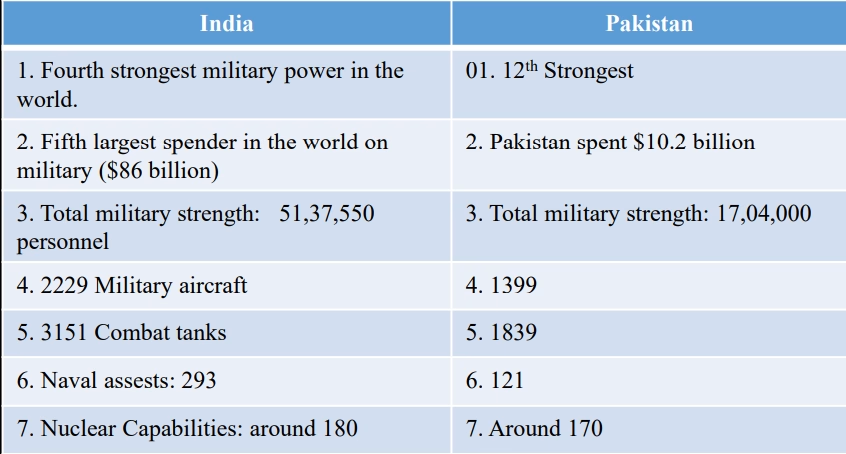
Chapter 08: Comparing the India and Pakistan’s military and nuclear capabilities
Military capabilities of India and Pakistan
Conclusion
The Indo-Pak wars have left a lasting impact on both nations, shaping their military strategies, political narratives, and regional relations. Understanding these conflicts helps us grasp the complexities of South Asian geopolitics and the importance of dialogue in maintaining peace.
Join Our Telegram Channel : UPSC With Deepak Prakash