
Introduction:
India refuses to sign the SCO draft statement, making headlines across the region. This unexpected move highlights New Delhi’s firm stance on key policy issues within the Shanghai Cooperation Organisation (SCO). In this blog, we explore the reasons behind India’s decision, its implications for regional diplomacy, and what it means for the future of the SCO.
Context:
- Defense minister Rajnath Singh on June 26, 2025 refused to sign the draft statement at the SCO meeting.
- He was in Qingdao, China to attend SCO Defense Minister’s Meeting.
- Currently, China has assumed the SCO chair for 2025.
Contents:
- What is SCO?
- Objectives of SCO
- History of SCO
- Organizational structure
- What happened at the SCO this year?
- Implications of MoD’s actions
- Way Forward for India in SCO
What is SCO?
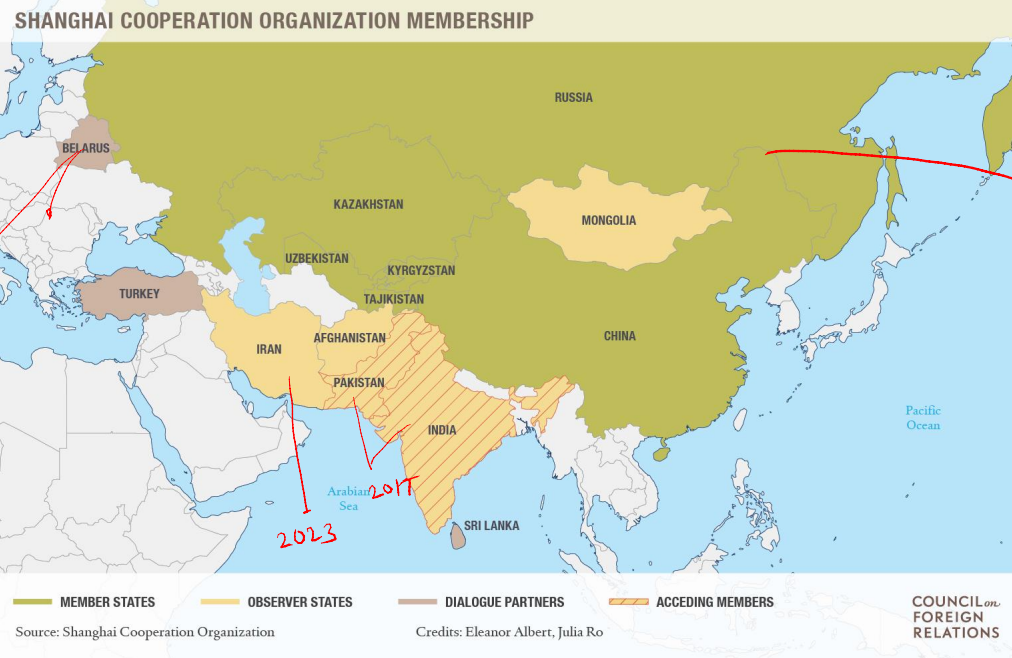
- The Shanghai Cooperation Organization is an inter-governmental politicalandsecurity organization founded in 2001 by four Central Asian Countries(Kazakhstan, Kyrgyzstan, Uzbekistan, Tajikistan) & Russia and China.
- The first summit was held in Shanghai, China in 2001.
- It aims to promote cooperation and mutual support in areas suchastrade,investment, energy, transportation and security.
- The Shanghai spirit is the core value of the SCO.
- Official working language of the SCO secretariat is Russian & Chinese.
- The group is the World’s Largest regional organization by geographical area and population.
- It is one of the few international organizations with primarily Asian members that deals with security issues.
- Its RATS regularly holds meetings and exchanges information.
Main Objectives
- Strengthen Relations among its member states
- Promote Cooperation in –
- Political Affairs ,economics & trade
- Cultural,Educational Sphere
- Energy,Transportation,Tourism & Environmental Protection
- Safeguard Regional Peace , Security & Stability
- Create a democratic ,equitable international politics & Economic Order
History of SCO
- The disintegration of the USSR created concerns regarding roleof extremist religious groups and ethnic tensions coming to the light.
- It was in light of this Shanghai Five was created to cooperate on security matters.
- It had its origins in Shanghai Five that was established in 1996.
- In 2001, Uzbekistan joined & the group was re-christened as the Shanghai Cooperation Organization.
- As of June 2025, the SCO has 10 members:
- Kazakhstan, Kyrgyzstan, Uzbekistan, Tajikistan, Russia and China (originalmembers)
- India and Pakistan (2017)
- Iran (2023)
- Belarus (2024)
Organizational Structure
- The SCO has Political, Economic and Security dimensions.
- The organization has two permanent bodies:
- a) The Secretariat in Beijing, China.
- b) The Regional Anti-Terrorist Structure in Tashkent (Uzbekistan).
- The SCO consists of several internal organizations.
Internal Organizational Structure
- The Council of Heads of State
- Highest decision making body
- Comprises the HoSs of all member countries
- Meets annually
- Strategic Direction
- The Council of Heads of Government
- 2nd Highest Council
- Meets Annually
- Discuss issues of multilateral cooperation
- The Secretariat
- Administrative Arm
- Main Permanent Exceutive Body
- Heades by Secretary-General.
- Nominated by CoM of Foreign Affairs & approved by HoS Council
- The Regional Anti-Terrorist Structure
- Coordinate efforts among members
- To combat Terrorism ,Separatism & Extremism
Note: In addition to these internal organizations, the SCO also consists of many other organizations such as The Council of Ministers of Foreign Affairs, The Council of National Coordinators, The SCO Business Council, The SCO Inter-Bank Consortium.
What happened at the SCO this year?
- Minister of Defense Rajnath Singh refuse to sign the draft statement.
- India wanted concerns on terrorism to be reflected in the document which was not acceptable to Pakistan and hence,theMoD refused to sign the draft statement.
Implications of MoD’s actions
- Checking China’s Clout
- Traditionally dominated by R & C
- Since 2022 , China’s footprint has grown
- China using that clout to shield Pakistan from adverse resolution
- Reinforcement of India’s Anti-terrorism stance
- Objected to omission of April 22 Pahalgam attack
- Signals that India will not compromise on core security concerns,especially cross-border terrorism
- Strained multilateral consensus
- Highlights growing divergences within the SCO-
- India v/s China-Pakistan
- Assertive foreign policy posture
- Reflects a more assertive diplomacy
- Priority to principled positions over symbolic unity
- Stand alone if NI is at stake
- Impact on SCOs Credibility
- over the effectiveness of SCO in addressing Terrorism
- Future engagements and regional dynamics
- clearly made out engagement with SCO only on basis of mutual respect & shared values
Way Forward for India in SCO
- It hinges on balancing its strategic interest with principled diplomacy.
- Reaffirm core principles but need to stay assertive
- continue to support zero tolerance for terrorism & territorial integrity but need to proactively shape future SCO agendas
- Deepen bilateral engagements within SCO
- Strengthen ties with Russia & Central Asia
- Build coalition to get support for its regional stability
- Go for P2P & cultural diplomacy
- Use soft power
- faster goodwill & counter balance geopolitical tensions
- Push for SCO reform & transparency
- Advocate Greater Transparency , Inclusivity within SCO decison making
- Encourage issue – based coalitions (on climate ,health)
- Can focus on counter-terrorism
- propose counter terrorism excersises + cybersecurity cooperation
- Focus on connectivity
- Revive Chabahar port & the INSTC can enhance India’s role as a regional connector
- Reaffirm core principles but need to stay assertive
Conclusion
India’s refusal to sign the SCO draft statement signals a clear assertion of its independent foreign policy and strategic priorities, even within multilateral platforms.
Join Our Telegram Group : UPSC with DeepakPrakash