
Introduction
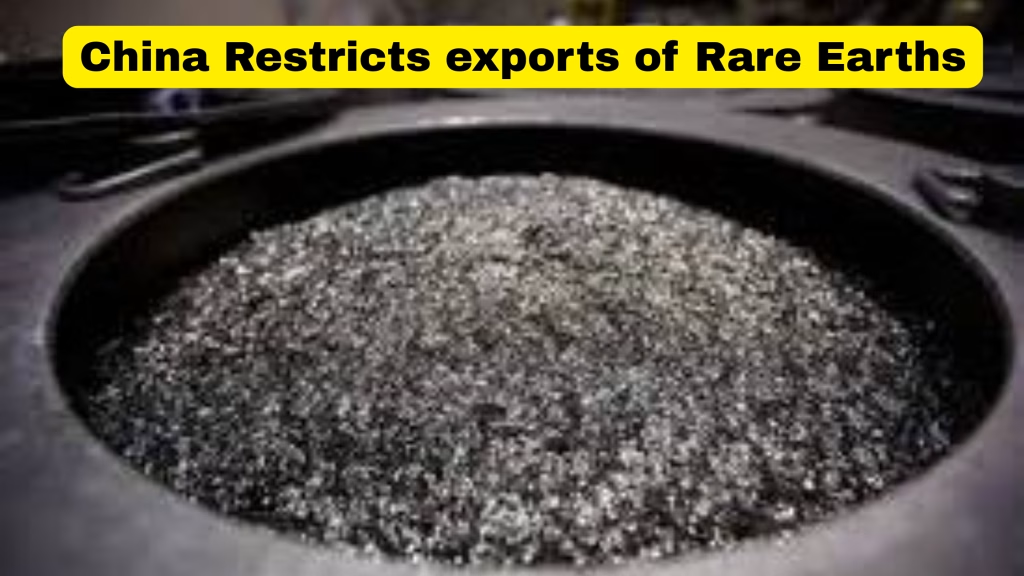
In a strategic move with far-reaching global implications, China restricts exports of rare earths, tightening its grip on the critical minerals that power everything from smartphones to electric vehicles and military equipment. As the world’s dominant supplier of these essential materials, China’s decision is poised to reshape international supply chains, raise geopolitical tensions, and push other nations to reassess their dependence on Chinese exports. This blog explores the reasons behind the restriction, its global impact, and what it means for the future of technology and trade.
In this blog post, we’ll explore the key provisions of China Restricts exports of Rare Earths.
Context
- China announced restrictions on the export of seven “rare earths” on April 4, soon after US President Donald Trump decided to impose tariffs on most of the country’s trade partners earlier this month.
- These elements are crucial for manufacturing high-value goods, including in the fields of defense and clean energy, as well as everyday items like smartphones and electronic displays.
- Since the 1990s, China has held an unrivalled dominance over rare earths, supplying 85 to 95 per cent of the world’s demand.
Content
- What are Rare Earths?
- Why are they called as Rare Earth?
- Economic Survey analysis on Domination of China in Rare Earth Mineral Processing.
- Why has China Restricted Rare Earth exports?
- What is concept of De-Risking?
- Way Forward
What are Rare Earths?
- Rare Earth Elements or Rare Earth Metals are a set of 17 chemical elements in the periodic table — cerium (Ce), dysprosium (Dy), erbium (Er), europium (Eu), gadolinium (Gd), holmium (Ho), lanthanum (La), lutetium (Lu), neodymium (Nd), praseodymium (Pr), promethium (Pm), samarium (Sm), scandium (Sc), terbium (Tb), thulium (Tm), ytterbium (Yb), and yttrium (Y).
- All have similar chemical properties and appear silvercoloured.
Why are they called as Rare Earth?
- According to the US Geological Survey, most Rare Earths elements are not as rare as their name suggests.
- Nearly all Rare Earth Elements are more abundant on average in the earths crust than silver, gold or platinum.
- The problem is it is difficult to find concentrated and economically mineable deposits.
- China holds expertise in the refining of Rare Earths more than any other country.
Uses of Rare Earth
- Are vital components in a wide range of modern technologies and industries including green energy, electronics and defense.
- The versatile nature of rare earth elements is evident in their applications:
- Electronics like in digital cameras, smartphones, digital screens, making phosphors, or substances that emit luminescence.
- Green technology such as wind turbines and electric vehicles.
- Healthcare like in MRIs, Laser Scalpels.
- Permanents Magnets: Neodymium magnets are permanent magnets made of Neodymium, Iron and Boron. They are used in automobile manufacturing.
Economic Survey analysis on Domination of China
in Rare Earth Mineral Processing
- Economic Survey (2024-25) mentions that in the care of rare earth minerals, China contributes to 63% of global mining and 90% of global processing output. (page 145)
- According to International Energy Agency, China controls 61% of production and 92% of processing.
- China has also acquired some of the world’s richest Rare Earths minerals deposits.
- In between 2023-24, Chinese companies have spent more than US $10 billion acquiring mining and critical mineral assets in Africa.
Why has China Restricted Rare Earth exports?
- In the 1990s, China’s government declared rare earths to be a “protected and strategic mineral”.
- Since then, it has periodically ordered restrictions on their extraction based on changing domestic and global demand, as well as during disputes with other countries.
- In 2022, China threatened to stop exporting rare earth materials to the US amid the trade war between the countries during the first Trump administration.
Impacts of this move
- The Economist noted that China’s central role in the sector means notable impacts would become visible soon enough.
- Price Rise: Prices would rise fast, as buyers began to stockpile.
- Diversification: Like in 2010, when japan had a dispute with china, Japan quickly moved to stockpile REEs, develop and acquire mines in countries such as Australia, and promote their recycling.
- De-risking: There would be argument for diversification of supply chains away from China while maintaining trade relations with it.
Way Forward
- Supply chain diversification.
- Capacity creation for processing and refining.
- Ores of rare earth oxides are found in, other than China, Russia, The US, India and Australia. These countries need to expand their production capacity.
Conclusion
As China restricts exports of rare earths, the global race to secure alternative sources intensifies. This move highlights the strategic importance of these minerals and signals a shift in global trade and technology dynamics.
Join Our Telegram Channel : UPSC with Deepak Praksah