Introduction
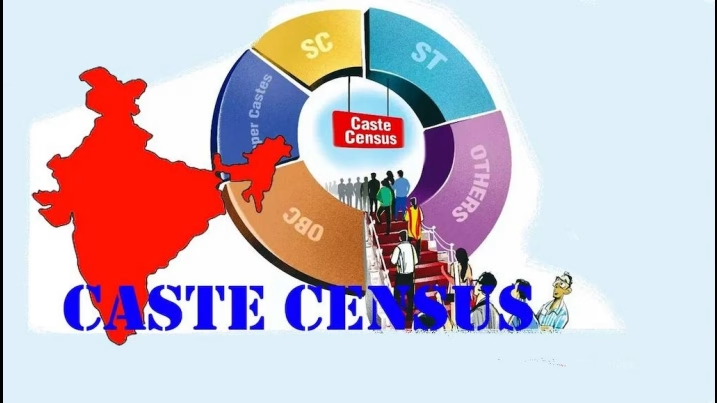
The nationwide caste census has emerged as a pivotal topic in contemporary Indian discourse, igniting debates across political, social, and economic spheres. For the first time in decades, the country is witnessing a systematic effort to gather detailed data on caste demographics beyond the Scheduled Castes and Scheduled Tribes. This development carries profound implications—not just for policymaking and affirmative action, but also for social equity and representation. In this blog post, we explore the significance of the caste census, its potential impact on governance, and what it could mean for India’s future.
Context
- The Cabinet Committee on Political Affairs (CCPA) has approved caste enumeration in the forthcoming population census.
- Caste count would be held for the first time in independent India.
- The Census could be conducted in the digital mode.
Content
- What is Caste Census?
- Which list of 7th schedule contain Census?
- History of Caste Census
- Previous attempt at Caste Census in Independent India.
- What was SECC?
- Legal Requirements for Caste Enumeration
- List to be used for OBC Enumeration
- Benefits of Caste Census
- Drawbacks of Caste Census
- Way Forward
What is Caste Census?
- It is inclusion of caste-wise breakdown of India’s population.
- The objective of caste census is to collect comprehensive data on the distribution of various caste groups within a given region or country.
- It tries to look into social, economic, and educational parameters to understand the working of caste dynamics in India.
Which list of 7th schedule contain Census?
- Union List
- Item no. 69 contains Census
Important for Prelims
Though Census is a Union subject, the Collection of Statistics Act 2008 allows states and local bodies to gather necessary data, as seen in Karnataka (2015) and Bihar (2023)
History of Caste Census
- Caste was enumerated in British India Censuses (1881-1931).
- Post-Independence, the 1951 Census excluded caste enumeration except for SCs and STs, who continue to be counted.
- In 1961, the GOI recommended states conduct their own surveys for state-specific OBC lists, as there were no central reservations for OBCs at that time.
Previous attempt at Caste Census in Independent
India.
- The 1951 Census excluded caste enumeration except for SCs and STs
- In the absence of such a Census, there is no proper estimate for the population of Other Backward Classes (OBCs), various groups within the OBCs, and others.
- The Mandal Commission estimated the OBC population at 52%, some other estimates have been based on National Sample Survey data.
What was SECC?
- With an approved cost of Rs 4,893.60 crore, the SECC was conducted by the Ministry of Rural Development in rural areas and the Ministry of Housing & Urban Poverty Alleviation in urban areas.
- However, the Socio Economic and Caste Census (SECC)- 2011, which was not conducted under the Census Act, 1948, failed due to poor design and execution, resulting in an implausible figure of 46 lakh castes.
- It was conducted through the Union Ministries of Rural Development and Urban Development which did not have prior experience of conducting sociological/anthropological surveys.
- Additionally, the questionnaire was poorly designed and asked open-ended questions about caste.
- The enumerators couldn’t distinguish between genuine castes, alternative caste names, larger caste groups, sub-castes, surnames, clan names, gotras, etc.
Legal Requirements for Caste Enumeration
- To include caste enumeration in the next Census, the government does not need to amend the Census Act.
- The Registrar General and Census Commissioner (RG&CC) is already empowered under existing law to design the census proforma.
- While finalizing the questions for the second phase (population enumeration), the RG&CC can simply add a question that goes beyond the existing categories of General, Scheduled Castes (SC), and Scheduled Tribes (ST) to ask whether a person belongs to the Other Backward Classes.
List to be used for OBC Enumeration
- The most crucial question the government must now address is which list to use while enumerating OBCs.
- In the last Census, for SCs and STs, the proforma relied on the official lists notified under the Constitution (Scheduled Castes) Order, 1950, and the Constitution (Scheduled Tribes) Order, 1950.
- These lists — currently comprising 1,170 castes under SC and 890 communities under ST — are periodically updated through amendments passed by Parliament.
- However, for OBCs, there is no single, consolidated list.
- A central list maintained by the National Commission for Backward Classes (NCBC) is used for reservations in central government jobs and educational institutions.
- Separately, each state maintains its own OBC list, which often differs from the central list.
- The key decision now before the government is whether to rely solely on the central list, which currently includes 2,650 communities, or to merge it with the various state lists, thereby significantly expanding the scope of enumeration.
Benefits of Caste Census
It is often said that “only what gets measured gets managed” and Caste Census allows the proper measurement of each Caste group.
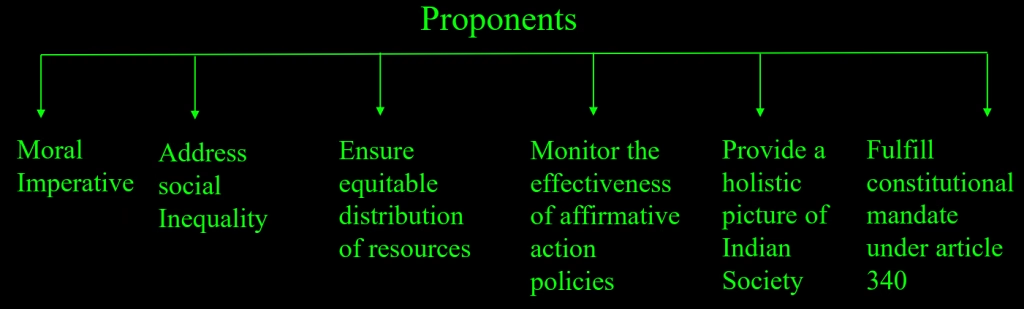
Moral Imperative
- Lack of proper caste data has allowed dominant OBC’s to disproportionately control income, assets and power.
- In 2018, the G. Rohini Commission analyzed more than 1lakh 30 thousand government jobs and found that 97% of the reserved jobs and seats have gone to 25% of OBC’s sub-castes.
- 37% of OBC had 0% representation in jobs and institutes.
To address social inequality:
- Caste remains a key social structure in India, evidenced by low inter-caste marriages, prevalent caste surnames and marks, residential segregation, etc.
- Only about 5% of Indian marriages were inter-caste as of 2011-12.
- Caste-based discrimination is still prevalent in many parts of India. A caste census can help identify the disadvantaged groups and bring them to the forefront of policy making.
To ensure equitable distribution of resources:
- Without accurate data on the population of OBCs and other groups, it is difficult to ensure equitable distribution of resources.
- A Caste Census can provide insights into the socio-economic conditions and needs of different caste groups.
To monitor the effectiveness of affirmative action
policies:
- To promote social justice, India is having affirmative action policies.
- However in the absence of Caste Census, it is nearly impossible to evaluate the impacts of these policies over the last 35 years.
Constitutional Mandate:
- Our Constitution too favors conducting a caste census.
- Article 340 mandates the appointment of a commission to investigate the conditions ofsocially and educationally backward classes and make recommendations as to the steps that should be taken by governments.
Drawbacks and Challenges of Caste Census
- Most immediate challenge
- Reinforces the Caste System
- Can lead to further social divisions
- Difficult to define caste
- Political Challenges
Reinforces the Caste System
- Opponents of a caste census argue that caste-based discrimination is illegal and that a caste census would only reinforce the caste system.
- They believe that focusing on individual rights and equal opportunities for all citizens should be prioritized over categorizing people based on their caste identities.
Can lead to Further Social Division
- Some argue that a caste census could lead to further social divisions and that it is better to focus on promoting social harmony instead.
- They believe that emphasizing commonalities among people rather than highlighting differences would be more beneficial for national integration.
Difficult to define caste
- Defining castes is a complex issue, as there are thousands of castes and sub-castes in India. A caste census would require a clear definition of castes, which is not an easy task.
- The Hindu Article “is the Caste Census a useful exercise”: Points towards multiple problems in conducting of caste census
- Upward caste mobility claim
- Downward caste mobility claim
- Problem of caste misclassification: Similar-sounding castes and surnames often lead to confusion in caste classification. For eg, in Rajasthan surnames like ‘Dhanak’, Dhankia and Dhanuk are classified as SC, while Dhanka is listed as ST.
Immediate Challenges
- On the political front, the first decision is which list to use for OBC enumeration.
- But the far more consequential challenge will emerge after the data is published. Until now, reservation policies have relied on projections and estimates from the last caste census in 1931. The upcoming Census will offer the first accurate estimate of India’s caste composition in nearly a century.
- This data is expected to prompt demands for recalibrating reservation quotas in proportion to the actual OBC population— and could even fuel calls to lift the 51% cap on total reservations, set by the Supreme Court.
Way Forward
- The data must not become a weapon for deepening faultlines and increasing polarization to win elections.
- It should not lead to the splintering and shrinking of the very notion of representation in a large and diverse democracy.
- Sociological and anthropological experts should draft statespecific caste lists, publish them online for public input, and finalize them before providing them to enumerators.
Mains Questions for Practice
Q. Discuss the significance of a Caste Census in the context of affirmative action policies and social justice in India. What are the potential benefits and drawbacks of such a census?
Q. Analyze the historical context of Caste Censuses in India, including the 1931 census and the 2011 SECC. What lessons can be learned from past experiences?
Q. Discuss the arguments for and against the implementation of a Caste Census. How can the potential benefits of such a census be maximized while minimizing the associated risks?
Conclusion
The caste census is more than just data collection—it’s a step toward inclusive policymaking and social justice. By understanding the true composition of society, India can work toward more equitable development and representation for all communities.
Join Our Telegram Channel : UPSC With Deepak Prakash