Introduction
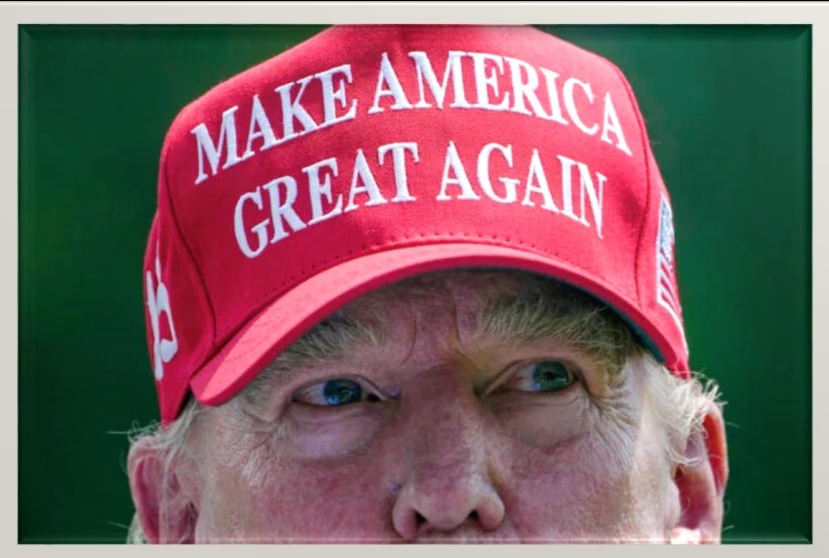
In today’s shifting global landscape, the slogan “Make America Great Again” continues to shape U.S. foreign policy narratives. As the world watches closely, a new diplomatic chapter—Rapprochement 2.0—is unfolding. This renewed phase of international engagement aims to balance nationalist priorities with strategic alliances, signaling a complex interplay between domestic strength and global diplomacy.
In this blog post, we’ll explore the key provisions of Make America Great Again and Rapprochement 2.0 .
Context
- Trump 2.0 and his continued emphasis on MAGA through various policies like increasing Tariff, threatening Canada and Greenland, killing the Green New Deal and putting an end to America’s endless bankrolling of other countries.
- US withdrawal from the very multilateral institutions and agreements it once helped establish sending mixed signals.
- Trump is unequivocally sending message that the USA is going to be transactional from now onwards.
- However, this seems not in sync with trump’s new world view i.e. Rapprochement 2.0
What is MAGA?
- MAGA movement emerged in the United States during the 2016 presidential campaign of Donald Trump.
- Its name is derived from Trump’s 2016 campaign slogan “Make America Great Again,” which became a rallying cry for many Trump supporters during his candidacy, his first term as president (2017–21), and beyond.
- MAGA 2.0 is in vogue again with the Trump returning back to White House.
Basis for MAGA
- Founded on the belief that the US was once a Great Country but has lost this status owing to foreign influence (Two Factors)
- Within its borders via immigration and multiculturism
- Without via Globalization or the increased integration of multiple national economies.
What are the Solutions to Achieve MAGA?
- Supporters of MAGA movement believe that this fall from grace can be reversed through America First policies that would incorporate policies like
- Greater degree of economic protectionism
- Reducing immigration particularly from developing countries.
- Encourage or Enforce traditional American values.
Note: Trump 2.0 foreign policies and economic policies seem guided by these considerations.
How are different Countries Coping with it?
- China:
- On this Sunday (16th March 2025) Beijing announced its most comprehensive package of policies to boost consumer spending in more than four decades (called it as a special action plan).
- Triggers for special action plan:
- To mitigate the impact of the intensifying trade war with the US (especially American tariff).
- Dent in China’s export sector.
- Lifting domestic consumptions.
- The plan features measures like increasing residents income and establishing a child care subsidy scheme.
2. Europe:
- Scrambling to beef up security as Trump’s America threatens to back out from the implicit defense guarantee it has extended to Europe since World War II.
- Germany exempting some defense spending from debt brake rules that prohibit running up debts.
- Also proposed to setup a 500 Billion Euro investment fund (financed by borrowing).
- Imposed tariff on American farm goods.
- There is also rumors concerning Canada. Canada seems pivoting towards Europe: with the possibility that Canada may choose to become 28th member of EU.
3. India:
- Between 2016-24, the NDA Government has increased protectionism by erecting higher tariff and non-tariff barriers, but now the ministry of commerce is in rethink mode.
- The trigger is Trump’s pursuit of trade parity and tariff reciprocity.
- Union budget 2025 cut basic customs duty on more than 2 dozen items.
- Reduction in average custom duty from 11.66 to 10.66%
- Duty cuts on high-end cars and motorcycles have been done to mollify Trump.
Implications on US itself
- Higher tariff + Trade War implies Higher inflation
- Runaway deficits + dilution of institutional autonomy implies that foreigners may start shifting to some other investment instead of investing in US Treasury.
- Higher inflation mean less room for Fed to cut rates further.
- China and the EU are targeting American farm goods with higher tariffs which could be discomforting for US.
- This could impact growth in the US.
Implications for Rapprochement 2.0
- Rapprochement 2.0 is about change in the world view of the USA.
- USA does not see Russia as a threat anymore.
- The U.S., in that sense, is breaking with the post-Second World War trans Atlantic consensus which see USSR as the most formidable enemy.
- In this Realist worldview, China is the systemic threat to the U.S’s primacy and a Sino-Russian alliance could make that threat perilous.
- It would entail a reorientation of America’s policy towards Russia — in a reverse order of what Henry Kissinger did in the 1970s.
- Rapprochement 2.0 requires America to win more allies and alienate China.
- MAGA 2.0 and recent actions of Trump, be it tariffication or more protectionism, go against Rapprochement 2.0 objectives.
- USA is, leave alone enemies, losing their own core allies like Europe and Canada.
- The USA appears to be breaking from that order which it has created post world war II, consequently many of its Asian, European allies are forced to diversify away from USA.
- MAGA 2.0 and Trump’s tariffs may end up blowing up the US dollar hegemony.
- As argued at Chatham House talk, Trump’s MAGA 2.0 and America first foreign policy will accelerate China’s push for global leadership:
- Since 2021, China has unveiled 3 global initiatives linked to its influence in the UN:
- The Global Development Initiative
- The Global Security Initiative
- The Global Civilization Initiative
- Since 2021, China has unveiled 3 global initiatives linked to its influence in the UN:
- If recently introduced DEFUND ACT (Disengaging Entirely from the UN Debacle Act) passes through, this amounts to surrender of Global Leadership in the hand of Chinese.
Way Forward
- Rapprochement 2.0 and Trump’s MAGA cannot exist together.
- If USA has to win the battle against China, it needs to be more accommodative.
- Trump’s moves – such as tariffs and annexation threats directed at allies – tend to undermine Rapprochement 2.0
- Trump needs to dial down its protectionist rhetoric.
Conclusion
Make America Great Again and Rapprochement 2.0 reflect a new era of U.S. diplomacy—where national interests meet global cooperation.
Join Our Telegram Channel : UPSC With Deepak Praksah