
Introduction
Hyper globalisation is a term used to describe the unprecedented acceleration of global economic, cultural, and technological integration that began in the late 20th century. Characterized by the rapid expansion of international trade, the rise of global supply chains, and the dominance of multinational corporations, hyper globalisation has transformed the way nations interact and economies function. Unlike traditional globalisation, hyper globalisation represents a more intense and far-reaching phase, driven by technological innovation, deregulation, and digital connectivity. While it has created new opportunities for growth and development, it has also intensified debates around inequality, national identity, and the sustainability of global systems. Understanding hyper globalisation is essential for grasping the complexities of today’s interconnected world.
In this blog post, we’ll explore the key provisions of Hyper Globalization .
Context
- Classical Economists like Adam Smith and David Ricardo always Hated any kind of restrictions on free trade.
- However, Trump 2.0 heralded a beginning of an era of high tariffs which to some extent mark the end of the era of hyper globalization.
- Hyper Globalization
- Evidences of Hyper Globalization
- Ideas of Classical Economists
- Adam Smith
- David Ricardo
- What is happening now?
- Trump 2.0
- Visible Impact of Trump 2.0
- Impact on the World
- Impact on India
- Way Forward
Hyper Globalization
- Hyper globalization refers to the period of accelerated and deepened globalization, particularly between the 1990s and 2008, characterized by a surge in global trade and capital flows.
- It’s an intensification of the globalization process, leading to a more integrated and interconnected world economy.
- It led to an unprecedented movement of capital and of people.Capital and labor flowed across the world.
Evidences of Hyper Globalization
- Increased Global Trade: Between 1990-2008; Goods trade increased from 15% to 25% while services from 18% to 32%.
- Cross border capital and labor flows:Between the same period it led to an unprecedented movement of capital and of people.
- Development of Global Supply chains: China became manufacturing power house.
- Economic growth and poverty reduction
Ideas of Classical Economists
- Adam Smith:
- He propounded the “absolute advantage” principle of international trade.
- Countries should specialize in producing goods that they can make more cheaply than others and import those they cannot manufacture as efficiently.
- David Ricardo:
- David Ricardo went one step further and propounded his theory of comparative advantage.
- Comparative advantage is the ability to produce a good or service at a lower opportunity cost than another producer.
- Absolute advantage: is about who is the most productive overall.
- Comparative advantage: is about who is most efficient at producing a specific good or service, considering what they have to give up to produce it.
Note: Give example of wine and cloth.
What is happening now?
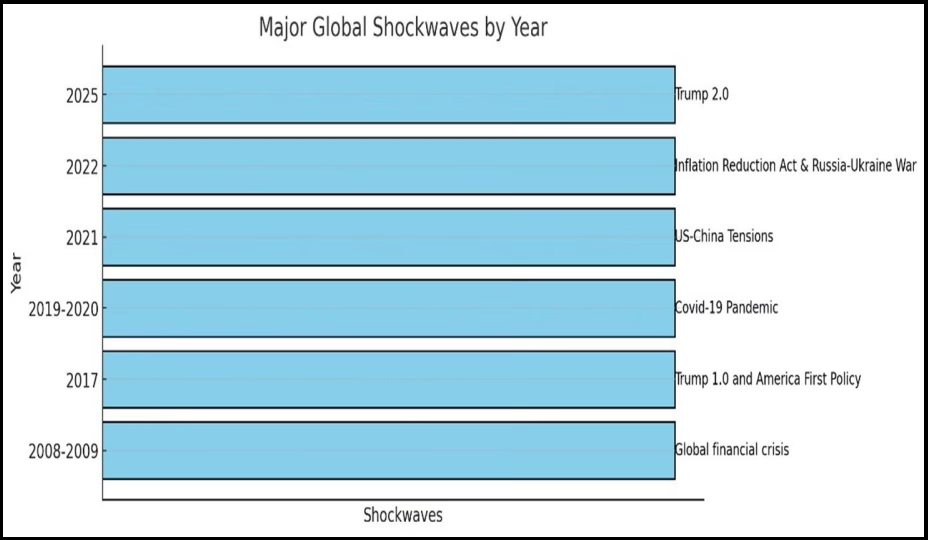
Signs of Demise of Globalization
- Recent actions by Trump 2.0
- Friend shoring and Nearshoring
- Introduction of Neo-Protectionism
- Fragmentation along geopolitical lines
What is happening now?
- These theories are now buried by Us President Donald Trump.
- Trump’s reciprocal tariffs and China-US Trade War.
a. From economic interests to strategic interests:
- The system of free trade was founded upon the ideas of comparative advantage and doux commerce (that economic interdependence makes men less prone to violence or irrational behaviour).
- This benign perspective was upended when the US began to get concerned over its own declining share of global semiconductor manufacturing capacity (from 37% in 1990 to 12% in 2020), as well as the strategic implications of Taiwan being home to fabs producing the bulk of the world’s chips.
- What if China annexed Taiwan and stationed its military on the island? Conflict in the Taiwan Strait would shut off a key shipping route, halting the production and delivery of chips, the production triggering a massive supply chain shock.
- In August 2022, Biden signed into law the Creating Helpful Incentives to Produce Semiconductors (CHIPS) and Science Act.
- President Trump’s tariffs and the CHIPS law — which aim to bring back manufacturing to the US through subsidies, tax credits and loan guarantees — stand for a different economic principle.
Trump 2.0
- The essence of Trump’s economic and trade policies:
- Cut down the size of his nation’s public debt
- Improve his country’s trade balance with its major trading partners
- Woo businesses to relocate or to invest in the domestic economy through a policy of carrot and stick
- Make the American economy efficient by reducing its fiscal deficit, which involves cutting the size of its bureaucracy and eliminating unwanted expenditure on international aid, and
- Improve the competitiveness of American products through innovation, technology infusion and through lower prices of energy
Visible Impact of Trump 2.0
- Dismantling Globalization.
- Killing WHO, Paris Climate Accord and OECD’s global corporate deal.
- Making difficult for people working for International Criminal Court through sanctions.
- Muscular tariff policy- For the first time in history, customs tariffs are being used as a weapon to achieve both geopolitical and economic objectives
- Putting policies like MAGA and America First.
- Undercutting WTO.
Impact on the World
- Tariff as a weapon: Trump is using customs tariffs as a weapon to achieve both geopolitical and economic objectives. This would increase inflation at the global level.
- Dismantling of various protectionist measures given to emerging and under developing economies.
- Demand of equal market access and reciprocity in import taxation by USA practically equate poorer countries with the rich industrialized countries.
- For example, mono-crop countries like Chad, Ivory Coast and Western African Union which only grow and export cotton,cannot survive without some protection for their domestic cotton growers.
- This would impact their export and ultimately their welfare.
- Reciprocal tariff by European countries as well as Rise in Trade Policy uncertainty.
- Increase in Inflation world wide
Potential Impacts on India
- Significant slowdown in economic growth,
- Reduced foreign investment,
- Limited access to global markets
- Potential job losses in export-oriented sectors,
- A decreased ability to attract skilled talent from abroad,
- Slower Technological Advancement,
- Reduced Geopolitical Influence impacting its overall development trajectory considerably.
Positive Potential Impacts on India
- A resurgence of Domestic Industries.
- Protection of small scale industries.
- Reduced dependence on Imports.
- More Balanced Economic Development.
Way Forward
- For now, the tide has turned against globalization, with geopolitics and strategic considerations trumping — quite literally — economics.
- Geopolitics and strategic considerations are important, so are trade and Globalization.
- European Countries may promote invoicing their internal trade in a currency other than US Dollar.
- Emergence of true Multipolarity
- Allowing Emerging economies like India to Provide Global Leadership.
Coclusion
Hyper globalisation has reshaped the world through rapid economic and technological integration. While it offers many benefits, it also brings challenges like inequality and environmental concerns. Moving forward, balancing growth with sustainability is key to making hyper globalisation work for everyone.
Join Our Telegram Channel: UPSC With Deepak Prakash